

The nut is half of the positioning system. A trapezoidal lead screw can be perfectly made and still deliver poor accuracy if the nut has the wrong thread form, the wrong material for the load, or no way to remove backlash. Selection comes down to six decisions, and they are best made in this order: thread form and size, number of starts, nut material, backlash design, lubrication provision, and the mounting interface.
This article works through each decision, with the numbers and failure modes that matter.
Start with the thread form, not the diameter
Metric trapezoidal thread, designated Tr, uses a 30 degree included angle. ACME uses 29 degrees. The two look similar and are not interchangeable.
That one degree matters. A nut cut to ACME geometry will bind or run loose on a Tr screw even when the nominal diameter matches, because the flank contact is wrong. This is the most common mismatch we see: a buyer orders a "16 mm nut" from a catalogue that does not state the thread standard, and it does not fit the trapezoidal lead screw on the machine.
Check four things against the screw drawing, not against the nominal size:
- Thread standard (Tr or ACME)
- Nominal diameter and pitch, written together as Tr16x4
- Pitch diameter tolerance class
- Direction of thread, if the application is left-hand
A custom or non-standard profile should be declared as such, because a standard nut will not fit it.
Single start or multi-start
A single-start screw advances one pitch per revolution. A four-start screw with the same pitch advances four pitches, giving four times the linear speed at the same motor RPM.
The trade-off is resolution and backlash. Multi-start threads have a larger lead angle, which means lower mechanical advantage and more sensitivity to axial play. For a machine that needs to hold position, single start is the safer choice. Multi-start earns its place where speed matters more than fine positioning, such as a fast Z-axis on a router or a pick-and-place travel move.
If the design calls for multi-start, specify the nut as matched to the screw rather than as a standard part, and expect to control backlash with preload rather than by tolerance alone.
Nut material
| Material | Load range | Lubrication | Best for | Main drawback |
| Polymer (POM, PA, PTFE-filled) | Light to medium | Self-lubricating, often no external lube | Quiet axes, light CNC, 3D printers, lab equipment | Softens above roughly 80 C, sensitive to debris |
| Bronze (tin or leaded) | Medium to heavy | Requires grease or oil | Milling machines, routers, actuators, production axes | Wears the screw if run dry; noisier |
| Cast iron or steel | Heavy | Frequent lubrication essential | Presses, heavy lathes, high-load transfer | Highest screw wear; only where load demands it |
Polymer nuts are the default for light machines because they do not score the screw and need little maintenance. The failure mode to watch is heat: a polymer nut on a screw that runs continuously in a warm enclosure will soften and lose preload.
Bronze is the general-purpose industrial choice. It carries high axial load, tolerates higher temperature, and works with a lubrication system. It must actually be lubricated: bronze on steel without a film between them will gall, and galling transfers material from the nut to the screw.
Cast iron and steel nuts are for load cases where nothing else survives. They should be treated as a wear part with a defined inspection interval.
Backlash: three designs, three jobs
Backlash is the axial free movement when direction reverses. On a CNC axis it appears as lost motion at every reversal, which shows up as poor circular interpolation and inconsistent part dimensions.
Plain nut
Simplest and cheapest. Accepts a small axial gap. Appropriate for one-directional motion, gravity-loaded axes, or manual machines where the operator takes up slack.
Anti-backlash nut
Two nut sections are forced apart axially, by a spring or by an adjustment, so each section contacts one flank of the thread. The gap is closed mechanically.
This is the right choice for a CNC axis where position matters. The adjustment needs to be checked periodically, because the spring relaxes or the wear gap grows.
Preloaded nut
Two nuts are separated by a ground spacer or shim, applying a fixed axial preload. It removes backlash without a spring and is stiffer than an anti-backlash design. The cost is added friction, which the motor has to overcome, and the preload is set at assembly rather than adjusted in service.
For most machine builds, the decision is between anti-backlash (adjustable, tolerant) and preloaded (stiffer, fixed). Select on stiffness requirement first.
Lubrication provision
A lubrication port is a specification item, not an accessory. If the design intends to use a manual oil pump or an automatic lubricator, the nut needs a port and the screw needs a way for the oil to distribute along the thread.
Polymer nuts are often supplied without a port because they are self-lubricating. That is acceptable for light duty and unacceptable if the machine runs continuously, where even a self-lubricating nut benefits from a film.
Grease choice follows the load. Light duty tolerates PTFE dry film. Medium and heavy duty need lithium grease or machine oil with EP additives. In food or medical equipment, the lubricant has to be food-grade, which usually rules out the standard bronze nut unless it is a sealed or plated variant.
Environment
- Dust and chips: a polymer nut traps less debris than a bronze nut, but neither tolerates abrasive grit. Bellows or a cover is the real answer.
- Moisture and washdown: stainless screw with polymer or nickel-plated bronze nut.
- Temperature above 80 C: polymer is out; bronze or cast iron, with a lubricant rated for the temperature.
- Vertical axes: the nut carries the load continuously, so preload and lubrication matter more than on horizontal axes.
Mounting interface
The nut has to attach to something. Two details cause most installation problems:
The flange pattern must match the carriage. A non-standard bolt pattern forces an adapter plate, and an adapter plate is a compliance path that shows up as backlash under load.
If a position sensor is mounted on the screw, the nut and its flange must not obstruct the coupling. On a build using an encoder on the screw end, check the nut travel against the encoder coupling envelope before finalising the carriage design.
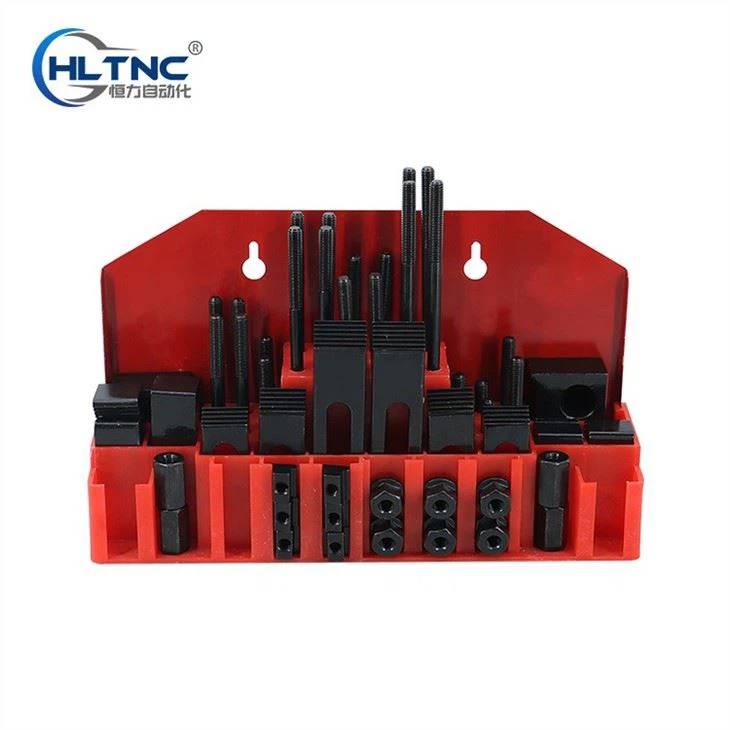
For the fastening hardware itself, standard clamping kits and parts reduce the risk of a mismatched bolt grade or a fastener that bottoms out before the flange seats.
Selection checklist
- Thread standard confirmed as Tr, and the nut declared for that standard
- Nominal diameter and pitch both specified, not diameter alone
- Start count chosen against speed versus resolution
- Material chosen against load, temperature and lubrication capability
- Backlash design chosen against required stiffness
- Lubrication port present if a lubrication system is planned
- Flange pattern matched to the carriage, no adapter plate if avoidable
- Sensor and coupling envelopes checked against nut travel

Can a bronze nut run without lubrication?
Not reliably. Bronze on steel without a lubricant film will gall, and galling pulls material from the nut onto the screw, which then damages the replacement nut as well. Even intermittent use needs a film.
What is the difference between a Tr nut and an ACME nut?
The thread angle. Metric trapezoidal is 30 degrees included; ACME is 29 degrees. Nominal diameter can be identical while the flanks do not match, which is why a nut must be specified by thread standard and not by size alone.
How much backlash is acceptable on a CNC axis?
It depends on the required positioning accuracy and how the control compensates. Where the control applies backlash compensation, mechanical backlash should still be minimised, because compensation is one-directional and does not fix varying lost motion under load.
If you are matching a nut to an existing screw, send the screw drawing or the measured thread profile and we will confirm which nut geometry and material fits the application.


