


Motor and Driver
A motor and its driver are one system, and the match is decided by three numbers: the flange and shaft your machine already has, the continuous torque the axis needs, and the current the drive can hold without derating. This page carries both halves of that pair — servo and stepper motors, the drives matched to them, and the cabling and brackets that finish the axis.
Start from a family

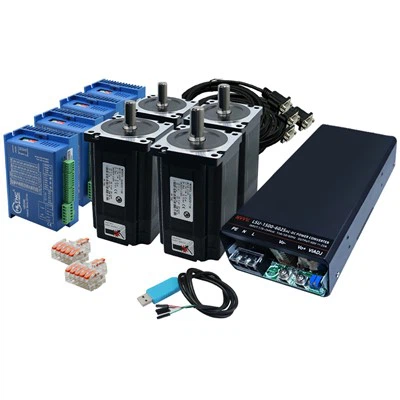


Motors and drives are matched pairs, and the match is decided by three numbers: the flange and shaft your machine already has, the torque the axis actually needs, and the current the drive can deliver continuously. We build servo motors from 7.1 kW to 82 kW and stepper motors from NEMA 17 to NEMA 52, and we supply the drivers that go with them — so the pairing is checked once, by us, instead of twice by two suppliers.
A motor and its driver are one system, not two orders
Buying a servo motor and a servo driver from separate suppliers is where most commissioning time is lost. The driver has to accept the motor’s encoder type, deliver its continuous current without derating, and understand its commutation. When both come from one place, those three checks happen before the order leaves, not after the machine is wired up. The same applies to stepper axes: a closed-loop stepper motor is only closed-loop if the driver reads its encoder and closes the loop correctly.
What we need from you to match a pair
The motor flange size and shaft diameter, the continuous torque your axis holds, and the supply voltage available in the cabinet. With those we return a motor and driver combination, plus the figures for both.
Absolute or incremental feedback
Absolute-encoder drives keep position without homing after a power cut, which matters on machines that cannot re-reference mid-job. Incremental encoders cost less and suit axes that home on every cycle. Say which behaviour your machine needs and it decides the driver family before anything else.
Servo or stepper: the decision in five questions
The two families are not competitors; they answer different questions. Work through these five and the choice is usually obvious.
| Question | Points to a servo | Points to a stepper |
|---|---|---|
| Does the load change during the move? | Yes — torque is controlled continuously | No — the load is known and steady |
| How fast must it settle? | Fast, with tight following error | Moderate; a short settle is acceptable |
| Does it hold position with power off? | Not required, or a brake is fitted | Yes — holding torque is inherent |
| What is the duty cycle? | Continuous, often near rated torque | Intermittent, with dwell time between moves |
| How much wiring is acceptable? | Encoder and power runs, plus tuning | Two wires plus step/direction |
Where a stepper is marginal on torque but must not lose position, a closed-loop stepper sits between the two: stepper cost and simplicity, with encoder feedback that reports a stall instead of silently missing steps.
Motor and driver series we supply
The sub-pages carry the model detail; this is the shape of the range so you can see which family applies before opening one.
| Family | What it covers | Where the detail is |
|---|---|---|
| Servo motors, standard and high power | 380 V, rated speeds of 1500 / 1700 / 2000 rpm, from 7.1 kW to 82 kW and 65 to 405 N·m | High power servo motor · industrial servo motors |
| Stepper motors, open loop | Two-phase and three-phase, NEMA 17, 23, 24, 34, 42 and 52 frames | NEMA 52 stepper motor · NEMA 42 3-phase |
| Closed-loop stepper motors | NEMA 17, 23, 24 and 34 frames, sold singly or as a kit with the driver | NEMA 34 closed loop · NEMA 23 kit |
| Servo drivers | Absolute-encoder drivers rated 7 A and 10 A output; drives for CNC axes | Absolute value servo driver · servo driver for CNC |
| Stepper drivers | Open-loop micro-stepping and closed-loop drivers with encoder input | HBS57 closed loop stepper driver · 2 phase micro drive |
| Integrated motor and drive | Motor, drive and feedback in one housing, sized 4.5 to 10 N·m | Integrated motor drive · integrated servo motor |
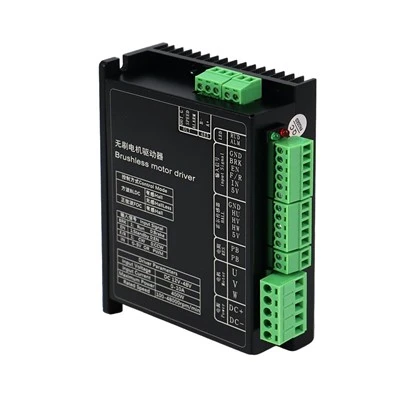
| Brushless and general-purpose motors | Brushless DC with its driver, small AC motors and the speed regulator that controls them | brushless machine · small AC motor · speed regulator |
| Machine-side parts | Motion controllers, power supplies, brackets and shielded motor cable | CNC motion controller · CNC power supply · stepper motor bracket · shielded motor cable |
Buying the pair from the manufacturer, not from two resellers
Matching the two halves is easier when one company builds both. Ask every servo motor manufacturer you shortlist whether it builds its own servo drives, because servo drives manufacturers and motor builders are often different firms, and that gap is where compatibility problems live.
If your search started with servo motor manufacturers in usa, the engineering questions do not change: a US-based servo motor supplier and a Chinese one are both working to the same frame standards, and what differs is freight, lead time and duty. The same holds for a stepper motor manufacturer or stepper motor supplier — check whether the closed-loop driver is theirs or a third party’s, because a driver from elsewhere means the pairing is yours to prove rather than theirs to warrant.
When you compare quotations, compare figures rather than company size. Two quotations from different motor drive manufacturers can look identical on power and differ by a third on continuous current. Servo motor companies that publish the current and the feedback type are easier to judge than those publishing only torque. Among the servo motor manufacturers and servo motor suppliers we compete with, few will state both the motor and the driver figures on one page; where stepper motor manufacturers and servo drive suppliers separate the two, the buyer carries the risk of the mismatch. Asking for both figures on one quotation is the fastest way to narrow a shortlist.
| Who you are comparing | What actually differs |
|---|---|
| A manufacturer that builds motor and driver | The pairing is designed and warranted as one; only one lead time to track |
| A supplier that resells both brands | Good availability, but the compatibility check becomes your engineering task |
| An overseas manufacturer against a domestic one | Same frame standards; freight, duty and lead time differ, not the mounting |
| Quotations showing power only | Cannot be compared on the number that causes commissioning faults |
The figures we publish, and the ones only you can supply
We would rather publish the electrical figures than have you discover them after delivery. These are the ones already on the sub-pages, quoted exactly as published.
| Item | Published figures |
|---|---|
| Servo motor range, 380 V | Rated speed 1500 / 1700 / 2000 rpm · rated power 7.1 to 82 kW · rated torque 65 to 405 N·m · rated current 24.6 to 143 A |
| Absolute value servo driver | HL-T3D-L15A-RABF and HL-T3D-L20A-RABF · 220 VAC · 3PH/1PH · 50/60 Hz · output 7 A and 10 A · 942 g and 959 g |
| HBS57 closed-loop stepper driver | Continuous output current 0 to 7.0 A · supply +16 / +36 / +80 VDC · pulse frequency to 200 kHz · encoder current to 50 mA · insulation resistance 500 MΩ |
| Integrated motor drive | Holding torque 4.5 / 6.5 / 8.5 / 10 N·m across four model variants |
What we will not guess
Your required continuous torque, the duty cycle, and the ambient temperature inside the cabinet. Torque figures assume a mounting and an ambient temperature; if your axis runs hot or the motor is enclosed, the usable torque is lower and the sizing has to account for it. Please give us the real duty rather than the nameplate.
Cabling, braking and the parts that finish the axis
Most lost time on a motion axis is not the motor. It is the cable that picks up interference, the brake resistor that is the wrong value, or a bracket that does not match the frame. Ordering these with the motor removes the second delivery.
| Part | Why it is ordered with the motor |
|---|---|
| Shielded motor cable | Encoder signals and switching currents share one run to the cabinet; unshielded cable is the usual cause of intermittent faults that appear only at speed. |
| Brake resistor | Required whenever the drive has to dissipate regenerative energy. Its value is specific to the drive and spindle combination, not a general-purpose part. |
| Motor bracket | Must match the frame size. A NEMA 34 bracket does not fit a NEMA 24 motor, and the mismatch is usually discovered on assembly day. |
| Power supply | The DC supply has to hold the drive’s voltage band under load, including the inrush when several axes start together. |
| Motion controller | Decides whether the drives take step/direction, analogue command or a fieldbus. Choose it before the drives, not after. |
What you can verify before shipment
Documents with the shipment
For every motor and driver we supply, the nameplate model code, the rated figures it was built to, and the wiring reference for that pairing. The code is what we trace back to if a replacement is needed later, so keep it with the machine record.
Ask for the matching figures, not just part numbers
Before you approve a quotation, ask us to state the motor’s rated torque, its rated current and the driver’s continuous output current on the same page. If the driver’s continuous current is below the motor’s rated current, the pair will not deliver the quoted torque continuously — that is the single most common mismatch, and it is visible on paper.
Send the flange, the shaft and the required torque and we will return the pairing with both sets of figures, the bracketry that matches, and the lead time. If you already have a motor and only need the driver, send its encoder type and rated current — that is enough to select.
How the pair is checked on our side
Motor and driver matched before dispatch
The pairing is settled on our side, not on yours. We check the motor’s rated current against the driver’s continuous output current, and the encoder type against the driver’s feedback interface, while the order is still open. Where the two are bought from separate suppliers, those two checks land on the buyer.
Amperage stated, not just kilowatts
A quotation that names only a power rating has left out the figure that decides whether the axis works. We put the torque the motor develops and the amperage it draws alongside the amperage the electronics can hold, on one sheet of paper, so two offers can be compared as numbers rather than as impressions.
Whole frame range and its fixings
Every frame size in the range is stocked, together with the mounting plates, the screened cable and the supply that feeds them. A plate drilled for the wrong footprint is the kind of fault that only shows up on assembly day, and it is avoidable while the order is still open.
Sized against your duty, not a catalogue page
Send the flange, the shaft and the load the axis actually carries, and the two halves come back sized for that load with both sets of figures. If the motor is already on the machine and only the electronics are missing, its feedback type and amperage are enough for us to choose.
Need one piece? Stepper and servo kits ship from local warehouses: shop motors and drivers.
Frequently asked questions
I already own the motor. Can you supply only the driver?
Yes. Send the motor’s encoder type and its rated current and that is enough to select the drive; the flange and shaft do not change the answer. What we will not do is size the drive on the motor’s power rating alone, because the driver has to hold the motor’s rated current continuously, not just its peak.
Open-loop or closed-loop stepper — how do I decide?
Open loop where the load is known and steady and losing a step would only mean re-homing. Closed loop where a missed step would scrap the job or stall the axis silently: the encoder reports the stall instead of letting the axis drift away from its commanded position. Frames run NEMA 17, 23, 24 and 34 in the closed-loop range, sold singly or as a kit with the driver.
What servo range do you actually build?
380 V servo motors at rated speeds of 1500, 1700 and 2000 rpm, from 7.1 kW to 82 kW, developing 65 to 405 N·m and drawing 24.6 to 143 A. The drivers quoted against them are the absolute-encoder units at 7 A and 10 A output, plus the CNC drive range.
Which figure decides whether a motor and driver pair will work?
The driver’s continuous output current against the motor’s rated current. If the driver’s continuous figure sits below the motor’s rated current, the pair will not deliver the quoted torque continuously — it will deliver it in bursts and derate. Every quotation we send states both figures on the same page so the comparison can be made on paper rather than at commissioning.
Absolute or incremental encoder — does it change the drive?
It changes the drive family before anything else. Absolute feedback keeps position through a power cut without re-homing, which is what machines that cannot re-reference mid-job need. Incremental feedback costs less and suits axes that home on every cycle. Tell us which behaviour the machine needs and the driver follows from it.
Send the motor flange and shaft, the continuous torque the axis holds, and the supply voltage in the cabinet. The reply comes back as a motor and a driver, with both sets of figures on one page.
Request a quote →