

Linear Guide
Why choose us
Incoming material and process control:
Rail steel is checked in before it is machined, and the production run is monitored stage by stage — profile, surface treatment, block assembly. Finished goods are inspected against the stated tolerance and specification before they are packed, not after a complaint arrives.
Tolerance and accuracy verification:
Dimensional accuracy on the rail profile is what sets positioning accuracy on the machine, so it is measured rather than assumed. Ask for the grade and the inspection figures with the order, and the same check is repeated on the block before dispatch.
Matching components and assemblies:
Rail, block, open bearing unit, shaft and grease fittings are quoted as one set, because a rail that arrives without its nipple or its dust cover still stops the axis. Series that interchange, HGR within its range and SBR with TBR, let a spare block be ordered against the rail already on the machine.
Engineering and quotation response:
Send travel, load direction, speed and environment and we reply with a series, a carriage count and a rail length. Enquiries are answered within 24 hours, and an urgent line-down request is picked up outside that window as well.

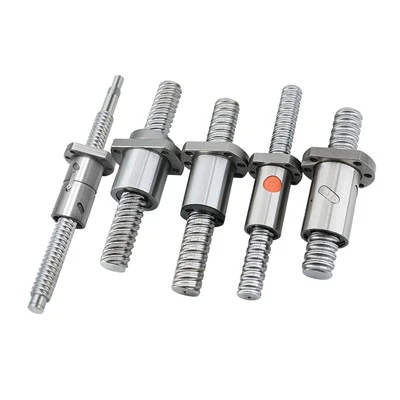


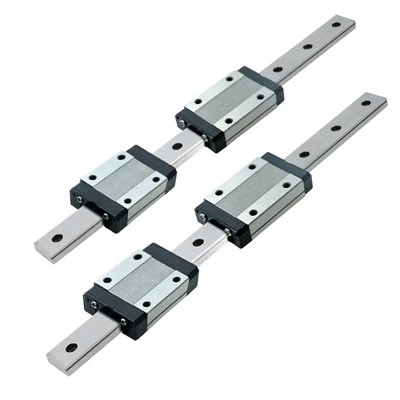

A linear guide is the rolling interface that carries a machine table along X, Y or Z and keeps that travel straight under load. It decides two things the drawing cannot: how much the carriage deflects when the tool bites, and how long the table holds position before the servo has to correct again. Pick the wrong one and the axis is either springy under a cut, or heavier and dearer than the duty ever justified.
How to choose a linear guide for your axis
Load direction and size
Ask first which way the load pushes. A table that mostly carries weight downward over a short stroke is the straightforward case, and a profile rail with ball rolling elements such as the HGR range is stiff and economical there. Where the load arrives as a real moment, as it does on a cantilevered head or an overhanging slide, roller guide rails earn their place: rollers present a much larger contact area and a much larger load bearing capacity than balls, and that is what stops a heavy table from rocking. On a supported-shaft axis the SBR and TBR rails take the load through an open box bearing unit, so the shaft is held along its whole length instead of only at the ends.
Stroke and rail length
Showroom stock runs at 300 mm, 600 mm, 1500 mm and 2000 mm, so an ordinary router or inspection stage needs no special order. Past that, roller guide rails are produced from 100 to 6000 mm, and the SBR series is built to be docked to any length — which is how a long travel is reached without one oversized rail. Long travel also changes the support calculation: confirm the rail is fixed at the spacing your deflection figure assumed, not just at two ends.
Space you can spare
Small machines are their own problem. Inside a 3D printer, an IC handler or a compact pick-and-place head, the MGN/MGR range goes down to a 12 mm rail with a 9 mm carriage and still runs a preloaded block. General duty starts at 15 mm and 16 mm, then moves to 20 mm and 25 mm for machine-tool axes. If you are retrofitting into an existing pocket, measure the mounting hole pitch on the old block before opening any catalogue.
Environment and lubrication access
Dust, coolant and heat narrow the choice as much as load does. TBR rails are heat treated and electroplated before shipment, and their steel resists corrosion from atmosphere, water and chemicals; SBR rails tolerate high and low temperature without deforming. Where the axis sits behind a guard, pick a series you can re-lubricate in place — MGN and TBR blocks carry a grease nipple, and the TBR nipple takes either a grease gun or a pipe joint for an automatic supply line. In medical and semiconductor work the self-lubricating design of the EGR cuts maintenance visits on its own.
Interchangeability and spares
Retrofits live or die on how easily a block swaps. HGR rails and blocks are dimensioned to be freely interchanged across that range, and the SBR support rail is interchangeable with the TBR series, so a machine rebuilt with one series' carriage can be re-ordered in the other. Where every changeover stops a line, that counts for more than a point of accuracy.
Linear guide series we stock
| Series | Structure | Load and accuracy character | Where it fits |
|---|---|---|---|
| HGR | Profile rail, ball rolling elements, hardened steel with surface treatment | Rigid under high load, high dimensional and positioning accuracy, low friction coefficient | CNC drilling, lathe and milling axes, 3D printers, textile and printing machinery |
| EGR | Four-row steel ball design, self-lubricating | Four-way equal load, so motion accuracy holds up under large torque | Packaging machines, surgical positioners, printing machines, semiconductor equipment |
| MGN / MGR | Miniature profile rail, steel, grease nipple | High rigidity in a 12 mm rail and 9 mm carriage, low noise, long life under repeated movement | 3D printers, IC handling, X-Y worktables, measuring and test equipment, pick-and-place arms |
| SBR | Support rail plus linear shaft plus open box bearing unit | High precision and torque capacity on long stroke; lighter than a traditional steel support rail | CNC machine tools, grinders, milling machines |
| TBR | Supported rail, heat treated and electroplated, grease nipple on the block | High strength and deformation resistance for heavy, long-stroke duty; low wear | Turret and gantry milling machines, lathes, spark machines, grinders, woodworking and packaging lines |
| Roller guide rails | Rollers on a parallel rail instead of balls | Large contact area, large load bearing, high sensitivity | Heavy tables and machine-tool axes where a ball rail would be marginal |
| Linear shaft rod | Chrome-plated shaft, high-frequency heat treated | Hard ground surface held for outer diameter, roundness and straightness | Guide rods, transmission shafts and pillars in automation and packaging equipment |
Key specs we will quote against
- ▪Every linear guide rail width we stock is a showroom item: 12 mm, 15 mm, 16 mm, 20 mm and 25 mm.
- ▪Miniature carriage: MGN9H block on a 300 mm rail.
- ▪Standard rail lengths held as showroom items: 300 mm, 600 mm, 1500 mm and 2000 mm.
- ▪Roller guide rail length range 100 to 6000 mm, and SBR support rails can be docked to any length.
- ▪Rolling friction of the TBR series is about 1/50 of a sliding guide rail — at the same feed rate that means far less drive power and far less heat left in the axis.
- ▪TBR and MGN blocks are fitted with a grease nipple, so lubrication can be done in place with a grease gun or fed from an automatic supply line.
- ▪SBR and TBR carriages interchange, so the spare block can be ordered in whichever series is in stock.
Applications and matching parts
Linear guide axes from this range turn up in three groups of machines. Machine tools come first: drilling machines, lathes, milling machines including turret and gantry mills, grinders, spark machines and 3D printers. Then automation equipment — textile machinery, printing machinery, drug dispensers, blood testing equipment, physical therapy machines, airway cleaning equipment, woodworking and packaging lines. Precision and electronic machinery is the third group: semiconductor equipment, scientific instruments, IC manufacturing equipment, X-Y worktables, precision measurement and test equipment, medical devices and the positioners inside surgical equipment.
What has to be ordered with the rail
- ▪On a supported-shaft axis, take the support rail, the linear shaft and the open box bearing unit together. They are matched as a set, and the SBR version is dimensioned to swap with TBR.
- ▪Plan lubrication at the same time as the rail: the grease nipple on an MGN or TBR block needs a grease gun or a pipe joint for an automatic supply line from day one.
- ▪Where the machine makes chips or dust, cover the exposed rail section with a guide rail dust cover. The uncovered rail is the part that wears first.
- ▪Keep the block part number on file, so a replacement HGR or SBR carriage is ordered against the rail already on the machine rather than against a photo.
Quality control you can verify
Ask for the steel grade and the surface treatment that went onto the rail — both are part of the specification, not a trade secret. The checks that matter at goods-in are the ones the rail will be judged by on the machine: hardness after heat treatment on the TBR range and on the shaft products, outer diameter, roundness and straightness on the ground shaft rod, and dimensional accuracy on the rail profile, because that is what sets positioning accuracy in the finished axis. TBR rails are heat treated and electroplated, and the mounting surface has to be flat before a block runs true along it. Certificates can be provided on request, and blocks are interchangeable within their series, so a spare carriage never has to be matched by eye.
Send the duty — travel, load direction, speed and the environment the axis works in — and the reply comes back as a series, a carriage count and a rail length instead of a catalogue page. That is how a linear guide gets specified once and re-ordered for every machine on the line. HLTNC follows the axis from quotation through to the spare block.