



CNC Part
Why choose us
Incoming material and process control:
Pump motors and impellers are checked against the DB-12 specification before assembly, and the copper coil, sealing ring and flange baffle are inspected as separate items. Turret and tool holder bodies are verified as 40CrMnTi forgings before heat treatment, so the parts that reach final assembly carry the material grade that was quoted.
Tolerance and accuracy verification:
Stated figures are re-measured rather than assumed: probe repeat accuracy below 0.01 mm, turret indexing repeatability ±0.005 mm, and 0.005 mm repeat clamping accuracy on the high-precision ER holders. Ask for the check to be run on your part number, and the measurement sheet travels with the shipment.
Matching components and assemblies:
Several of these items are only useful as a set, so they are quoted that way: the plasma lift with fixture and dual limit switches, the ER holder with the collets and nut for your shank range, the pump on a flange distance that meets your coolant tank, and the probe with its 2 m cable and NPN-NO output.
Engineering and quotation response:
Selection support starts from the process, not the catalogue: machining material, batch size, spindle specification and workpiece dimensions are used to narrow the function family before anything is priced. Questions are answered within 24 hours, and a drawing or sample can be matched to a model number before you commit to an order.





Buying CNC parts for a machine tool is a fit question, not a catalogue question. Everything on this page sits in one of five jobs around a machine: coolant delivery, edge finding and tool setting, tool clamping, cabinet wiring and torch height control. Choose the family first, then the size. A pump is judged by lift and flow, a probe by repeat accuracy, a collet chuck by clamping range, a cable by core count and shield. Miss the family and no specification will save the job.
How to choose CNC parts by function family
Five questions decide almost every enquiry we get, and they are worth answering before you compare prices.
- ▪What is the heat load? If the machine runs a steady flood of coolant across a lathe or a mill, a vertical pump is the cheap answer: 12 L/min and 3 m of lift clears chips and holds tool temperature down. If the cut is micro-milling in a mould or a phone-shell wall, flooding distorts the part, so you want air-liquid spray aimed at the cutting zone instead. If the heat source is a laser generator rather than a cutting edge, neither works, because the generator needs a chiller with its own refrigerant circuit.
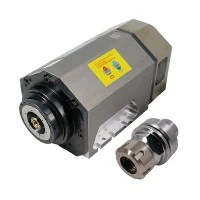
- ▪Do you need to find the edge, or hold the tool? Edge finding, coordinate tool setting and the deviation detection that holds a tight tolerance on a mill, lathe or industrial printer belong to the 3D touch probe. Clamping a cutter in a router spindle belongs to the ER collet chuck. A probe does not fix runout and a collet chuck does not measure anything.
- ▪How many tools per setup? A woodworking or engraving spindle keeps one tool mounted, so a tool holder is enough. Turning a part that needs turning, milling, drilling and tapping in a single setting means a turret, because indexing brings the next tool to the work without an operator.
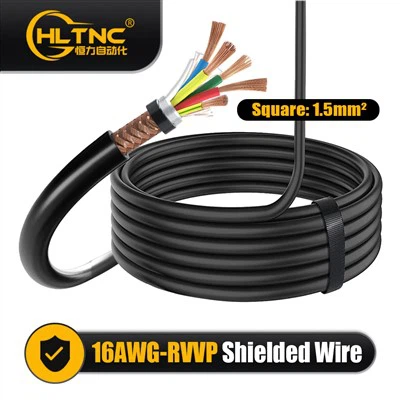
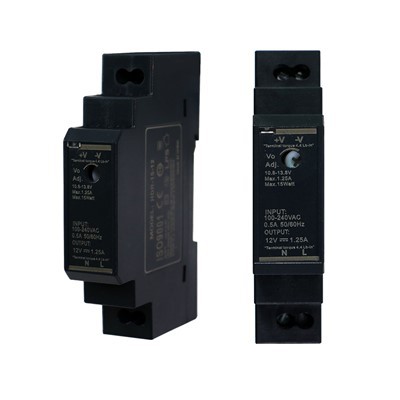
- ▪What runs through the cabinet? Spindle and VFD leads laid next to encoder or signal wire are the usual source of random faults, so that run calls for shielded cable with a braided copper screen. Power for PLC modules, sensors, relays and CNC controls on a DIN rail is a separate buy, sized in watts rather than in cores.
- ▪How harsh is the environment? Cast iron dust and dry chips punish anything that is not sealed; plasma cutting adds height control, where a lifter with dual limit switches matters more than raw travel speed.
CNC parts series overview
The mapping below is the fastest way to shortlist. Every series in it is one we build; sizes are the ones quoted most often.
| Function family | Series / model | Structure | Fit and accuracy | Typical job |
|---|---|---|---|---|
| Cooling, flood | DB-12 40W water pump | Vertical single-stage centrifugal, pure copper coil motor, wear-resistant impeller, sealing ring plus flange baffle | 12 L/min, 3 m lift, 220V/380V, 105 mm flange distance, ≤65 dB | Machining centres, lathes, mills, grinders, cutting machines; standard cooling tanks and filtration |
| Cooling, spot | BPV3000 copper tube sprayer | Venturi air-liquid mixing, aluminium alloy valve body, independent air and liquid knobs | 2 mm inner diameter nozzle, 200 mm copper tube, M5 mounting thread | Lathes, machining centres, engraving mills, robot cutting cells |
| Cooling, laser source | CW-5000 / CW-5200 chiller | Compression refrigeration cycle, 2 temperature control modes, optional heating and water purification | 800 W and 1400 W cooling capacity, ±0.3°C control, CW-5000AI at 16 L/min | UV, CO2 glass tube and fiber laser generators on cutting, marking and engraving machines |
| Measuring | 3D touch probe | Contact trigger, internal sensing structure converting displacement into an NPN-NO signal | Repeat accuracy <0.01 mm, over 3 million triggers, XY ±4 mm and Z 2 mm overtravel, 5-24V | Edge finding, coordinate tool setting, dimension calibration on mills, lathes, CMMs and industrial printers |
| Tool interface | ER8-ER32 spindle tool holder | 40CrMnTi forging, vacuum heat treatment and quenching, taper interference fit | Clamping range 1-20 mm, repeat clamping accuracy 0.005 mm on the high-precision type | Metal engraving, PCB, acrylic, wood milling, jade carving; DIY and water-cooled spindles |
| Tool interface | HAK31 turret, HAK 63/80/100/125 | Three-tooth disc indexing and positioning, servo, hydraulic or electric drive, internal cooling | Indexing repeatability ±0.005 mm, 380V supply, front or rear tool post | CNC lathes running turning, milling, drilling and tapping on one workpiece |
| Electrical | RVVP multi-core shielded cable | Oxygen-free copper cores, double-layer braided shield, flame-retardant PVC sheath, filler rope | 300V rated, 2-5 cores, 0.3-1.5 mm² (22-16 AWG) | PLC modules, surveillance, weak-current projects needing signal integrity |
| Electrical | Rail-mounted switching power supply | High-frequency switching stage, triple protection coating, flame-retardant housing, 35 mm DIN rail | 15-240 W output, 100-240V AC in, 5/12/24/48V options, up to 95.5% efficiency | PLC racks, I/O modules, sensors, relays, servo drives and CNC control cabinets |
| Plasma | CNC plasma cutting machine lift (basic and enhanced) | Motorised lead screw drive, metal torch fixture, dual proximity switches, complete set with sensors | 83 mm fixture bore, M8 locking, pairs with 60-120 A plasma supplies | Torch height control on plasma tables cutting 5-50 mm plate |
Key specs of our CNC parts
Numbers only mean something next to the job they limit, so each figure below is one we can measure on the machined part you are buying.
- ▪Probe: repeat accuracy below 0.01 mm across a 50-200 mm/min feed window, more than 3 million trigger cycles, XY ±4 mm and Z 2 mm overtravel protection, 5-24V supply, 2 m cable, 80 g body. The overtravel allowance is what turns a wrong approach into a spring-back instead of a scrapped probe.
- ▪Turret: indexing repeatability ±0.005 mm on the HAK 63/80/100/125 sizes at 380V, with internal cooling through the tool station. A repeatable index is what keeps tool offsets valid across a batch.
- ▪Tool holder: ER8 for 1-5 mm shanks, ER11 for 1-7 mm, ER32 for 1-20 mm, and 0.005 mm repeat clamping accuracy on the high-precision type. Double-headed models take 4-7 mm motor shafts without heating, up to 5-30 mm where the shaft is heated. Match the collet to the shank, not to the machine.
- ▪Sprayer: 2 mm inner diameter copper nozzle and a 200 mm copper tube on a standard M5 mounting thread, so it drops onto existing machine mounting positions without a bracket.
- ▪Pump: 40 W, 12 L/min, 3 m actual lift, 220V/380V dual voltage, 105 mm standard flange distance, running noise ≤65 dB, MTBF up to 30,000 hours. The vertical split body is what cuts maintenance time by 60% when a wearing part is replaced.
- ▪Chiller: ±0.3°C temperature control accuracy, 800 W on the CW-5000 against 1400 W on the CW-5200, 16 L/min on the CW-5000AI for high-flow loops, service life of 3 years or more, CE, RoHS and REACH documentation.
- ▪Cable: 300V rated with 2-5 cores, from 22 AWG / 0.3 mm² up to 16 AWG / 1.5 mm². The cross-section table lets you size a run by length and load instead of guessing.
- ▪Power supply: 100-240V AC input, 12V or 24V DC output as standard with 5/12/24/48V options, 15-240 W, conversion efficiency up to 95.5% and no-load consumption under 0.25 W. The no-load figure is what matters in a cabinet that idles overnight.
- ▪Plasma lift: 83 mm torch fixture bore with M8 screw locking, dual proximity limit switches, pairing with 60-120 A plasma power supplies on 5-50 mm plate. Choose the basic version for small cutting tables and the enhanced version where the lifter runs a heavy-duty cycle.
Where these CNC parts are used
The same part rarely ends up in one industry, so the list below follows the machine rather than the sector.
- ▪Machining centres, CNC lathes, milling machines, grinders and cutting machines: flood coolant, spot cooling and, on lathes, the indexing turret.
- ▪Laser cutting, marking and engraving machines: chiller on the generator loop, with models matched to the laser power.
- ▪Engraving machines, routers, industrial 3D printers, CMMs and motion-control cards: probe for edge finding and calibration, ER holders for clamping.
- ▪Plasma tables cutting 5-50 mm plate, including factory mass production lines: torch height control with dual limit protection.
- ▪Control cabinets and automated lines, AGV and sorting equipment, semiconductor and packaging machinery: DIN-rail power and screening for signal runs.
Parts worth ordering at the same time: ER collets and nuts to match the holder series, a boring bar and tool discs for the turret, a coolant tank and filtration matched to the 105 mm flange, a drag chain for cable runs into the moving axis, limit switches and a handwheel for setup work, and spare filters and nozzles for the sprayer. Buying the joint once avoids a second shipment at commissioning.
What you can verify before shipment
Ask for these on your own part number; each one is something the factory can show you rather than describe.
- ▪Repeat figures re-measured per batch: probe below 0.01 mm, turret indexing ±0.005 mm, ER high-precision holder 0.005 mm.
- ▪Probe documentation: CE marking with EU Machinery, EMC and Low Voltage Directive papers, plus the factory inspection sheet and traceable technical file.
- ▪Pump sealing and noise: thickened sealing ring with flange baffle, verified on a wet loop, with ≤65 dB running noise recorded.
- ▪Cable: stated cores and cross-section compared with the marking, with no shortfall in length or conductor area.
- ▪Power supply: overvoltage, overcurrent and short-circuit protection functions demonstrated, triple protection coating, no-load draw under 0.25 W.
- ▪Plasma lift shipped as a complete set of lifter, fixture and sensors, so nothing extra has to be sourced at commissioning.
- ▪Probe packing: anti-static bag, 5-layer corrugated carton, EPE buffer and PP strapping, with box-level and image-level anti-damage checks.
Send the machine model, the material and the operation you are buying for, and we will come back with the family, the size and the matching parts instead of a price list. That is how most CNC parts orders here start: a drawing, a photo of the spindle or the coolant tank, and one question about fit. Bulk quantities, OEM labelling and custom requirements are quoted on the same basis.