

Hey there! As a supplier of SBR Support Rails, I often get asked about the parallelism requirement for installing multiple SBR Support Rails. It's a crucial topic, and I'm here to break it down for you in a way that's easy to understand.
First off, let's talk about what SBR Support Rails are. They're an essential part of linear motion systems. These rails provide support and guidance for linear motion components, like Linear Shaft Rods. They work hand - in - hand with other parts to ensure smooth and accurate movement in various applications, such as in industrial machinery, automation equipment, and even some precision instruments.
Now, when it comes to installing multiple SBR Support Rails, parallelism is super important. Parallelism refers to the state where the rails are perfectly parallel to each other. If the rails aren't parallel, it can lead to a whole bunch of problems.
One of the main issues is uneven wear. When the rails aren't parallel, the load on the linear motion components, like the bearings that run on these rails, won't be distributed evenly. Some parts of the bearings will experience more stress than others. This uneven stress causes some areas of the bearings and the rails themselves to wear out faster. Over time, this can lead to premature failure of the components, which means more maintenance and replacement costs for you.
Another problem is reduced accuracy. In applications where precision is key, like in CNC machines or 3D printers, non - parallel rails can cause the moving parts to deviate from their intended path. This deviation can result in inaccurate cuts, prints, or other operations. For example, if you're using SBR Support Rails in a 3D printer, non - parallel rails might cause the print head to move slightly off - course, leading to a poorly printed object.
So, what's the parallelism requirement? Well, it depends on the specific application. In general, for most industrial applications, a parallelism tolerance of around ±0.05mm to ±0.1mm per meter of rail length is a good rule of thumb. However, in high - precision applications, the tolerance can be much tighter, sometimes as low as ±0.01mm per meter.
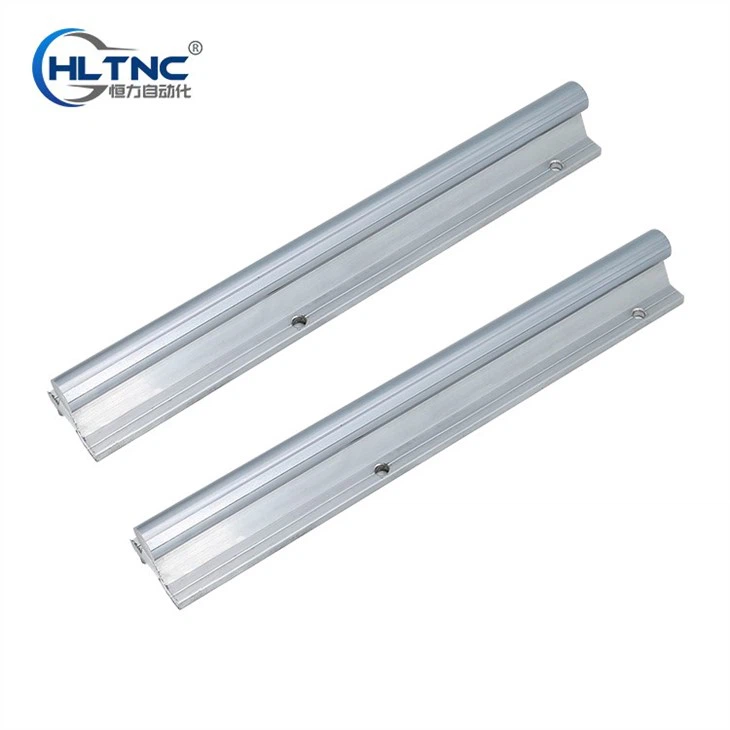

To achieve the required parallelism during installation, you need to follow a few steps. First, make sure the mounting surface is flat and clean. Any dirt, debris, or unevenness on the mounting surface can affect the parallelism of the rails. You can use a surface plate and a precision level to check the flatness of the mounting surface.
Next, use proper alignment tools. Laser alignment tools are great for this purpose. They can help you accurately position the rails and ensure they're parallel to each other. You can also use feeler gauges to measure the gaps between the rails at different points to check for parallelism.
When installing the rails, start by loosely mounting them. Then, use the alignment tools to adjust the position of the rails until they meet the parallelism requirement. Once the rails are in the correct position, tighten the mounting bolts gradually and evenly. This helps to prevent any distortion of the rails during the tightening process.
It's also a good idea to perform a final check after installation. You can use a dial indicator to measure the parallelism of the rails again. This double - check ensures that the rails are still parallel after the installation process is complete.
Now, let's compare SBR Support Rails with TBR Support Rails. TBR Support Rails are another type of support rail used in linear motion systems. While both SBR and TBR Support Rails serve the same basic function of providing support and guidance, they have some differences.
SBR Support Rails are typically more lightweight and are suitable for applications where space and weight are a concern. They're also often more cost - effective, making them a popular choice for many general - purpose applications. On the other hand, TBR Support Rails are usually more robust and can handle heavier loads. They're often used in applications where high - load capacity is required, such as in heavy - duty industrial machinery.
Whether you choose SBR or TBR Support Rails, proper installation and parallelism are crucial for optimal performance.
If you're in the market for SBR Support Rails, we've got you covered. Our SBR Support Rails are made from high - quality materials and are manufactured to strict quality standards. We offer a wide range of sizes and specifications to meet your specific needs. You can check out our SBR Support Rail product page to learn more about our offerings.
If you have any questions about SBR Support Rails, their installation, or parallelism requirements, don't hesitate to reach out. We're here to help you make the right choice for your application. Whether you're a small - scale hobbyist or a large - scale industrial manufacturer, we can provide you with the support and products you need.
If you're interested in purchasing our SBR Support Rails, we'd love to have a chat with you about your requirements. Contact us, and we can start a discussion about how our products can fit into your project. We're committed to providing you with the best products and service, so let's get the ball rolling on your next linear motion project!
References
- Linear Motion Handbook, published by a leading industry association
- Technical documents from linear motion component manufacturers


