As a supplier of SBR Support Rail, I am often asked whether our product can be used in high - speed applications. In this blog, I will delve into the characteristics of SBR Support Rail, analyze its suitability for high - speed scenarios, and compare it with related products in the market.
Characteristics of SBR Support Rail
SBR Support Rail is a crucial component in linear motion systems. It is designed to provide stable support and guidance for linear motion elements. The SBR Support Rail is typically made of high - quality materials, which ensure its durability and precision. The surface treatment of the rail is optimized to reduce friction, allowing for smoother linear motion. This smoothness is essential for maintaining the accuracy of the motion system, especially in high - speed applications where even a small amount of friction can cause significant deviations in the motion path.
One of the key features of SBR Support Rail is its rigidity. A rigid rail can better withstand the dynamic forces generated during high - speed movement. When a linear motion system operates at high speeds, there are inertial forces, vibration forces, and acceleration/deceleration forces acting on the rail. A rigid SBR Support Rail can resist these forces without significant deformation, ensuring the stability of the entire system.

Analyzing Suitability for High - Speed Applications
Advantages
- Reduced Friction: As mentioned earlier, the optimized surface treatment of SBR Support Rail reduces friction. In high - speed applications, friction is a major concern as it can lead to increased heat generation and wear. Low friction allows the motion system to operate more efficiently, with less energy consumption and longer service life. For example, in a high - speed pick - and - place robotic system, the low - friction SBR Support Rail can enable the robot to move quickly and accurately, reducing the time required for each operation.
- High Precision: The manufacturing process of SBR Support Rail ensures high precision in terms of its dimensions and surface flatness. In high - speed applications, precision is crucial to ensure that the moving parts reach the intended positions accurately. For instance, in a high - speed printing machine, the SBR Support Rail can provide precise guidance for the print head, ensuring clear and accurate printing.
- Dynamic Load Capacity: SBR Support Rail is designed to have a relatively high dynamic load capacity. In high - speed applications, the moving parts often carry significant loads, and the rail needs to be able to support these loads without failure. This high dynamic load capacity allows the SBR Support Rail to be used in a wide range of high - speed industrial applications, such as automated assembly lines and high - speed conveyors.
Challenges
- Vibration Management: At high speeds, the linear motion system can generate vibrations. These vibrations can affect the accuracy of the motion and may even cause damage to the rail and other components over time. Although the SBR Support Rail is designed to be rigid, additional measures may be required to manage vibrations, such as the use of damping materials or proper mounting techniques.
- Heat Dissipation: The low - friction design helps to reduce heat generation, but in extremely high - speed applications, there may still be a significant amount of heat produced. If the heat is not dissipated effectively, it can cause thermal expansion of the rail, which may affect its dimensional accuracy and the performance of the entire motion system.
Comparison with TBR Support Rail
The TBR Support Rail is another type of support rail commonly used in linear motion systems. When comparing SBR Support Rail with TBR Support Rail in high - speed applications, there are several differences.
In terms of friction, the SBR Support Rail generally has a lower friction coefficient due to its surface treatment technology. This gives it an advantage in high - speed applications where energy efficiency and smooth motion are important. However, the TBR Support Rail may have a higher load - carrying capacity in some cases, which could be beneficial in applications where heavy loads need to be moved at high speeds.
The design of the SBR Support Rail often emphasizes precision and smoothness, making it more suitable for applications that require high - accuracy positioning. On the other hand, the TBR Support Rail may be more robust and better able to withstand harsh operating environments, which could be a consideration in high - speed industrial applications where the system is exposed to dust, debris, or other contaminants.
Role of Black Aluminium Plate in High - Speed Applications
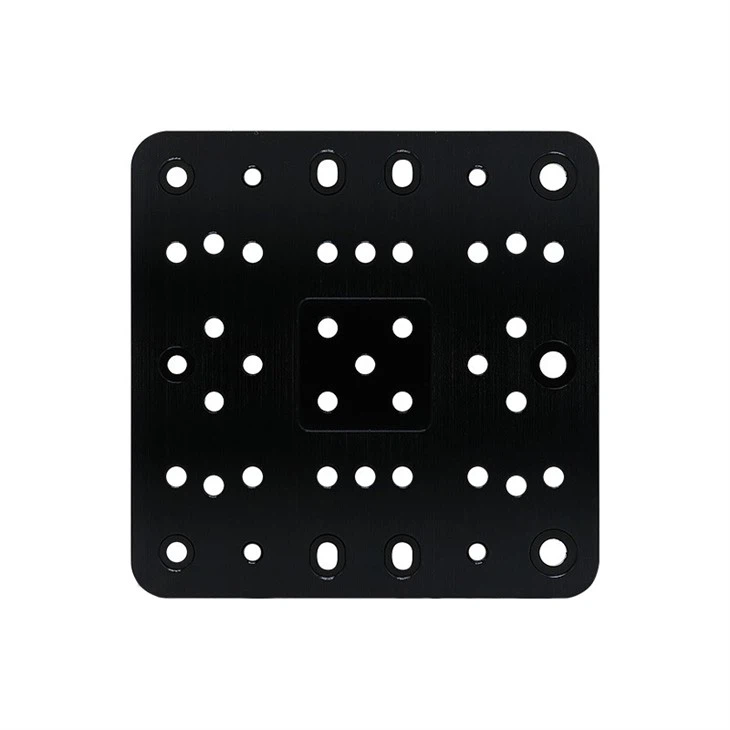
The Black Aluminium Plate can play an important role in conjunction with SBR Support Rail in high - speed applications. The black aluminium plate can be used as a mounting surface for the SBR Support Rail. Its high - strength and lightweight properties make it an ideal choice for high - speed motion systems.
The black colour treatment of the aluminium plate can also have benefits. It may help with heat dissipation, as black surfaces are better at absorbing and radiating heat compared to other colours. In high - speed applications where heat management is crucial, the black aluminium plate can contribute to maintaining the stability of the SBR Support Rail and the entire linear motion system.
Conclusion and Call to Action
In conclusion, SBR Support Rail has many characteristics that make it suitable for high - speed applications. Its low friction, high precision, and relatively high dynamic load capacity are significant advantages. However, challenges such as vibration management and heat dissipation need to be carefully addressed. When compared with TBR Support Rail, SBR Support Rail has its unique strengths, and the choice between the two depends on the specific requirements of the application. The black aluminium plate can further enhance the performance of the SBR Support Rail in high - speed scenarios.
If you are considering using SBR Support Rail in your high - speed application or have any questions about our products, we welcome you to contact us for a detailed discussion. Our team of experts is ready to provide you with professional advice and customized solutions. Let's work together to achieve the best performance in your linear motion systems.
References
- "Linear Motion Systems: Design and Applications", John Wiley & Sons
- "Materials Science and Engineering for Mechanical Components", Cambridge University Press