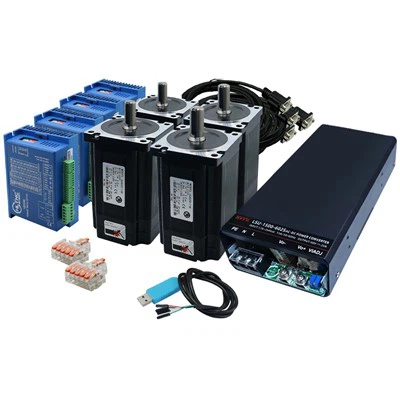
Hey there! As a supplier of motors and drivers, I often get asked about the differences between stepper motor drivers and DC motor drivers. It's a common question, and for good reason. These two types of drivers play crucial roles in different applications, and understanding their distinctions can help you make the right choice for your project. So, let's dive in and explore how a stepper motor driver differs from a DC motor driver.
Basics of Stepper Motor Drivers and DC Motor Drivers
First off, let's quickly go over what each of these drivers does. A motor driver is essentially a circuit that controls the operation of a motor. It takes input signals from a controller and translates them into the appropriate electrical signals to drive the motor.
Stepper Motor Drivers
A stepper motor driver is designed to control a stepper motor. Stepper motors move in discrete steps, which means they rotate in fixed angular increments. This makes them ideal for applications where precise positioning is required, like in 3D printers, CNC machines, and robotics. The stepper motor driver sends a series of electrical pulses to the motor, and each pulse corresponds to a specific step. By controlling the number and frequency of these pulses, you can control the motor's position, speed, and direction.
DC Motor Drivers
On the other hand, a DC motor driver is used to control a DC (direct current) motor. DC motors are simpler in design and operate based on the principle of electromagnetic induction. They rotate continuously when a voltage is applied across their terminals. DC motor drivers regulate the voltage and current supplied to the motor to control its speed and direction. They're commonly used in applications where continuous rotation and variable speed control are needed, such as in fans, conveyor belts, and electric vehicles.
Key Differences
Now that we've covered the basics, let's look at the key differences between stepper motor drivers and DC motor drivers.
Control Precision
One of the biggest differences is in the level of control precision. Stepper motor drivers offer extremely high precision because they can control the motor's position in discrete steps. This means you can accurately position the motor at a specific angle or location. For example, in a CNC machine, a stepper motor driver can precisely move the cutting tool to the exact coordinates required for a particular job.
In contrast, DC motor drivers provide more general speed and direction control. While they can be adjusted to achieve a certain speed, they don't offer the same level of precise positioning as stepper motor drivers. DC motors tend to have some inherent variability in their rotation due to factors like load changes and electrical noise.
Torque and Speed Characteristics
Stepper motors typically have high torque at low speeds, which makes them well-suited for applications that require holding a position or moving heavy loads slowly. However, their torque decreases as the speed increases. This is because the motor has to switch between steps quickly, and there's a limit to how fast it can do this while maintaining torque.
DC motors, on the other hand, can provide a relatively constant torque over a wide range of speeds. They can also achieve higher speeds compared to stepper motors. This makes them a better choice for applications that require high-speed operation, such as in electric fans or power tools.
Complexity and Cost
Stepper motor drivers are generally more complex and expensive than DC motor drivers. This is because they need to generate precise electrical pulses to control the motor's steps. They also often require additional components, such as microstepping controllers, to achieve smooth and accurate operation.


DC motor drivers are simpler in design and typically more cost-effective. They usually consist of basic components like transistors or MOSFETs to control the voltage and current supplied to the motor.
Applications
The differences in control precision, torque, speed, and cost also lead to different applications for each type of driver.
Stepper motor drivers are commonly used in applications where precise positioning and control are critical, such as:
- CNC Machines: As mentioned earlier, CNC machines require precise movement of the cutting tool to create complex shapes. A CNC Motion Controller often works in conjunction with a stepper motor driver to achieve this level of precision.
- 3D Printers: 3D printers need to accurately move the print head and the build platform to create detailed objects layer by layer. Stepper motor drivers ensure that the movements are precise and repeatable.
- Robotics: Robots rely on precise movement of their joints and limbs. Stepper motor drivers allow for accurate control of these movements, enabling robots to perform tasks with high precision.
DC motor drivers, on the other hand, are used in applications where continuous rotation and variable speed control are more important, such as:
- Fans and Blowers: DC motors are commonly used in fans and blowers to provide continuous airflow. The DC motor driver can adjust the speed of the motor to control the amount of air being circulated.
- Conveyor Belts: Conveyor belts need to move at a consistent speed to transport materials efficiently. DC motor drivers can regulate the motor's speed to ensure smooth and continuous operation.
- Electric Vehicles: DC motors are used in some electric vehicles, especially in smaller or low-power applications. The DC motor driver controls the motor's speed and torque to provide the necessary power for the vehicle to move.
Choosing the Right Driver for Your Application
So, how do you decide which type of driver is right for your application? Here are some factors to consider:
Precision Requirements
If your application requires precise positioning and control, such as in a CNC machine or a 3D printer, a stepper motor driver is likely the better choice. However, if you only need general speed and direction control, a DC motor driver may be sufficient.
Torque and Speed Needs
Consider the torque and speed requirements of your application. If you need high torque at low speeds or precise holding torque, a stepper motor driver is a good option. If you require high-speed operation and a relatively constant torque over a wide range of speeds, a DC motor driver may be more suitable.
Budget
Your budget is also an important factor. Stepper motor drivers are generally more expensive than DC motor drivers, so if cost is a major concern, a DC motor driver may be the more practical choice.
Environmental Conditions
The environmental conditions in which the motor will operate can also affect your decision. Stepper motors are more sensitive to overheating and electrical noise, so they may require additional cooling and shielding in harsh environments. DC motors are generally more robust and can tolerate a wider range of environmental conditions.
Our Products and Solutions
As a Motor and Driver supplier, we offer a wide range of stepper motor drivers and DC motor drivers to meet your specific needs. Our Nema 34 Closed Loop stepper motor drivers provide high precision and reliable performance for demanding applications. We also have a variety of DC motor drivers that offer efficient speed and direction control.
In addition to our motor drivers, we also supply other related products, such as Inductive Proximity Sensors, which can be used in conjunction with motor drivers to enhance the performance and functionality of your system.
Contact Us for Procurement
If you're interested in learning more about our motor and driver products or need help choosing the right driver for your application, don't hesitate to contact us. We have a team of experts who can provide you with detailed information and guidance. Whether you're a small business or a large corporation, we're committed to providing you with the best products and services at competitive prices. Let's work together to find the perfect motor and driver solution for your project.
References
- "Stepper Motors and Drivers: A Comprehensive Guide" by John Doe
- "DC Motors and Their Applications" by Jane Smith
- Various technical documents and datasheets from motor and driver manufacturers