How to Choose a Servo Motor for CNC: Size, Torque and Encoder Explained
Every couple of weeks someone sends us a photo of a machine frame - sometimes it is a router they are building in a garage, sometimes a production mill that has been sitting idle since its original servo died - and asks the same thing: "what size servo motor do I need?"
The honest answer is that there is no chart that solves this in one glance. But there is a short list of questions we walk through every time, and once you answer them, the right choice stops being a guess. This is that list, in the order we ask it.
Start with torque, not power
The most common mistake we see is people picking a servo by wattage - "0.75 kW should be enough, right?" - without checking torque at the speed they actually run. Power tells you how fast the motor can do work. Torque tells you whether it can do the work at all. A machine that needs to push a heavy gantry will stall a high-speed, low-torque motor while a smaller-looking motor with higher torque at low RPM will handle it fine.
Work it backwards instead:
- Continuous torque - what the motor must hold during normal cutting or positioning. This is the number that matters for sizing.
- Peak torque - what it must produce for acceleration. Servo drives typically allow 2-3x rated torque for short bursts, so do not oversize for the peak.
- Speed - at what RPM does the application need that torque? Check the torque-speed curve, not just the rated speed.
A good rule of thumb we use for CNC applications: pick the motor whose continuous torque is at least 1.5x the calculated load torque at the operating speed. Then check the inertia match (next point) before you finalize anything.
Inertia ratio: the number nobody wants to calculate
This is the part that actually trips people up, and honestly, it is the part we spend most of our time on when customers send us their machine specs.
The motor has to accelerate not just the load, but its own rotor. If the load inertia is several times the rotor inertia, the servo loop has to work harder, gains get lowered to stay stable, and you end up with a machine that "works" but feels sluggish and overshoots at every stop. In practice:
- Load-to-rotor inertia ratio under 5:1 - most general CNC applications run fine with standard tuning.
- 5:1 to 10:1 - workable, but expect to spend time on gain adjustment. This is where a drive with good auto-tuning earns its keep.
- Above 10:1 - either add a gearbox/reducer or pick a bigger motor. Fighting this with gain settings alone rarely ends well.
If the numbers sound fiddly, send us the load weight, the ball screw pitch or rack module, and the travel speed - that is a standard calculation for us and we will come back with the inertia ratio and a motor suggestion. We do this every week, it takes us a couple of minutes, and it saves you ordering the wrong motor twice.
Incremental or absolute encoder?
This is a cost-versus-convenience decision, and the answer depends on what the machine does between power-offs.
An incremental encoder counts pulses from a reference point. Power down, move the axis by hand, power up - the controller has lost its position reference and needs a home switch cycle. Cheap, simple, fine for machines that home on startup anyway.
An absolute encoder remembers its position through power cycles. Our T3D servo drive supports 17-bit absolute encoders, single-turn and multi-turn. With multi-turn, you lose the home cycle entirely - power up and the machine knows exactly where each axis is. For a production machine that gets cycled dozens of times a day, that saves real time and removes a source of operator error.
If you are building a one-off machine and do not mind a home switch, save the money. If it is going to run in production, we usually recommend the absolute encoder and never hear anyone complain about it.
Match the drive to the motor - and check the voltage
The drive is half the system, and it has to match the motor's rated current, not just the power rating. A 10A drive running a motor that draws 12A under load will trip overcurrent alarms all day. Check the drive's continuous and peak current against the motor's specs.
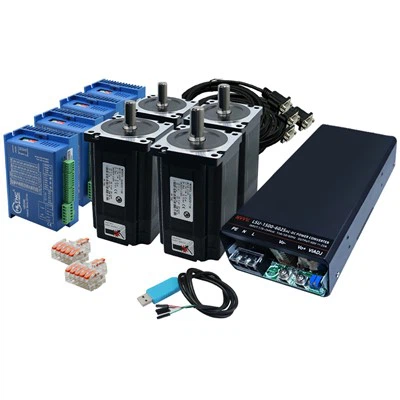
On our side, the common pairing questions look like this: the servo motor line covers from small 0.1 kW units up to higher-power frames, and the drives span the same range - our T3D series handles 0.1-1.5 kW with 220VAC input, and the 3.8 kW servo sits above that for spindle-class applications. Input voltage matters too: a drive wired for 220V fed with 380V will not last long, and neither will the motor it was driving.
What we tell every customer
To be fair, most of the sizing questions we get are answered by three pieces of information: load torque at the operating speed, inertia ratio, and encoder type. Get those three right and the rest is paperwork - cable lengths, brake requirements, connector types.
Send us your machine parameters - load weight, drive method (ball screw, rack, belt), speed, and how often the machine gets powered off - and we will come back with a motor and drive recommendation, usually the same day. No obligation, and honestly, we would rather answer it now than help you troubleshoot a mismatch three months later.
Email: admin@hengli-hltnc.com | WhatsApp: +86 13884328311