Short answer: vibration in a ball screw nearly always comes from five sources. They are accuracy grade and shaft runout, nut preload and backlash, alignment and end support, operating speed near the screw's natural frequency, and frame rigidity. The first three account for most cases seen on the shop floor. The last two decide whether an axis that passes inspection still shakes at production speed.
Vibration is one of the most frequent complaints from machine builders, and it rarely announces itself as a single fault. It erodes positioning accuracy, shortens nut and bearing life, and turns into unplanned downtime once the amplitude reaches the workpiece. The five sources below come up repeatedly in application reviews, together with the measurement that identifies each one on your axis.
Cause 1: Screw Design and Accuracy Grade
Vibration often starts with the screw you chose. A general-purpose rolled screw is adequate for light loads at moderate speed, but on a high-speed or heavy-load axis the internal clearance shows up as vibration long before anything breaks. Three parameters separate quiet screws from noisy ones, and all three appear on the datasheet if you know where to look: ball diameter relative to groove radius, groove geometry, and accuracy grade.
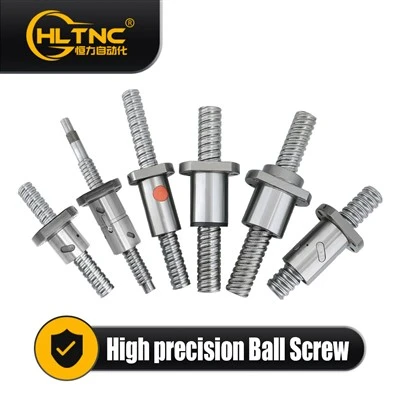
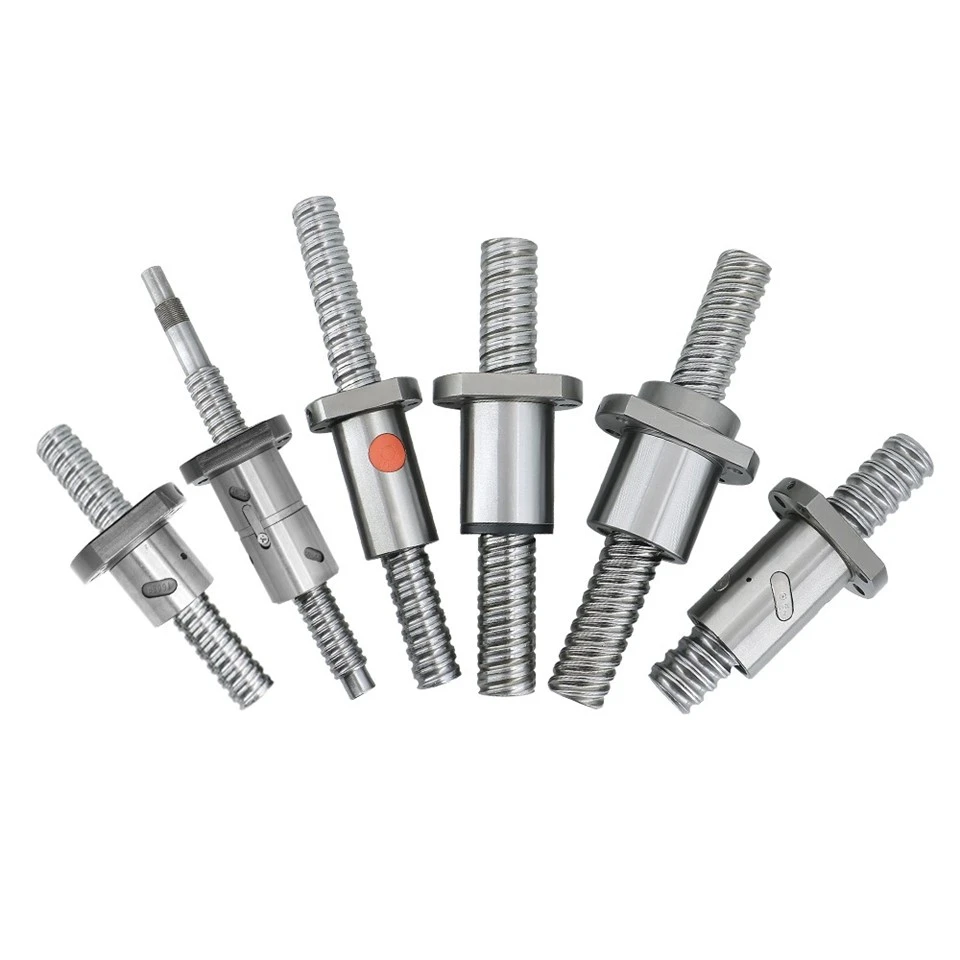
The SFE series uses a larger ball diameter and an optimised groove profile. A larger ball contacts the raceway over a longer arc, which reduces ball slip during acceleration and spreads load across more contact points. In milling axes where customers replaced a standard screw with an SFE, measured vibration fell by close to 30%.
If you are building a pick-and-place or small CNC axis, the SFU ball screw rolled and ground to C7 to C3 is usually the right starting point. Ground screws hold tighter lead and runout tolerances, and runout is the parameter that matters most at speed. An unsupported shaft with 0.1 mm of runout at 1,000 rpm is enough to make you feel a distinct shake through the entire axis.
Cause 2: Nut Preload and Backlash
Preload decides how the nut behaves when the axis changes direction. Backlash is the small gap between screw, balls and nut that opens and closes on reversal, and the moment that gap closes the axis receives a jolt. If your axis only moves one way, this is barely visible. On a gantry robot or any axis that reverses under load, it becomes the dominant vibration source.
A double nut removes it. The DFU ball screw uses two nuts with adjustable preload, so the ball train stays under tension in both directions and there is nothing to close up on reversal. The practical difference is large. One automation line ran a single nut with about 5 mm of backlash, which produced 0.5 mm of positioning error at the workpiece. After the switch to a DFU screw, the error dropped to 0.05 mm and the vibration at reversal disappeared with it.
Preload also holds the balls against the raceway, which stops them bouncing during acceleration. Set it to your actual load rather than the maximum the nut allows, because excess preload raises drag torque and heat, and heat introduces its own drift.

Cause 3: Installation and Alignment
A machine that comes back with vibration usually has a bad installation rather than a bad screw. Alignment comes first. If the screw axis and the motor shaft are not concentric, the coupling forces radial movement into the screw on every revolution, and both the nut and the end bearings wear faster as a result. Check runout with a dial indicator at both ends before you tighten the coupling, not after.
End support is the second installation fault. Plain bearings are enough if your loads are light and your speeds low. Heavy or high-speed axes need angular contact bearings that carry axial and radial load together. A customer once mounted a 2 m screw on plain bearings; it bowed under load, the bow produced resonance at working speed, and the axis shook badly. Correct end supports removed the problem immediately.
Lubrication belongs here as well, because a dry ball train generates friction, heat and vibration in that order. Use a grease specified for ball screws and re-apply roughly every 500 operating hours for most applications, with the interval shortened as speed rises. Over-greasing is its own fault: excess grease raises drag torque. You want the smallest amount that leaves a visible film on the raceway.
Cause 4: Operating Speed and Resonance
Every screw has a natural frequency, and if you run close to it you amplify whatever vibration already exists. For a single screw with end supports, the estimate you need is:
f = (π/2) × √( E·I / (ρ·A·L4) )
Here E is Young's modulus, I the moment of inertia of the shaft section, ρ the material density, A the cross-sectional area and L the screw length. The term that changes most in practice is L, and it enters to the fourth power, which is why a longer screw loses stiffness so quickly and why intermediate support helps so much.
The fix is rarely a new screw. If you shift the working speed or the acceleration profile away from the calculated frequency, the amplitude drops. One CNC router ran at 1,500 rpm with severe vibration; moving the working speed to 1,700 rpm, about 200 rpm clear of the natural frequency, removed it without any hardware change.
Cause 5: Damping and Frame Rigidity
When the four causes above are addressed and some movement remains, damping deals with the residue. Vibration dampers clamp onto the nut and absorb the small shocks that pass through the ball train. They reduce amplitude, they do not correct a misaligned or under-supported axis, so put them at the end of the sequence, not at the start.
Frame rigidity sets the floor for all of it. A frame that deflects under cutting load moves the rail and the screw relative to each other, and the screw reads that movement as vibration. Thin aluminium plate is the usual culprit on custom builds, and no amount of screw quality will compensate for it in your machine.
Troubleshooting Matrix
| Symptom | Most likely cause | First check |
|---|---|---|
| Shake appears only above a certain speed | Resonance near natural frequency | Calculate f, then shift working speed or acceleration |
| Jolt at every direction change | Backlash from a single nut | Measure lost motion, then move to adjustable preload |
| Continuous buzz at all speeds | Shaft runout or coarse accuracy grade | Dial indicator at both journals, then review C grade |
| Amplitude grows with load | End support inadequate, shaft bowing | Check bearing type and support spacing |
| Rattle plus heat build-up | Lubrication quantity or type | Confirm ball screw grease and 500 h interval |
Matching the Screw to the Application
| Series | Best fit | Why it helps |
|---|---|---|
| SFU, rolled, C7 | General automation on a budget | Lowest cost, adequate below moderate speed |
| SFU, ground, C7 to C3 | Pick-and-place, small CNC | Tighter lead and runout, less shake at speed |
| SFE | High-speed axes, electronics assembly | Larger balls reduce slip and load per contact |
| DFU, double nut | Reversing axes, gantry robots | Adjustable preload removes backlash |
Across customer machines where these four series were matched to the application, measured vibration fell by 20% to 40% depending on the starting point. The largest gains came from axes that had been running a single nut on a reversing load, or a rolled screw at high speed.
Frequently Asked Questions
Can vibration be fixed without replacing the screw?
Often, yes. Alignment, end support, preload and lubrication cover the majority of cases you will meet. Replacement becomes necessary when shaft runout or the accuracy grade is the limiting factor, because neither can be corrected by adjustment on site.
Why does the shake appear only at high speed on my machine?
Because the axis is approaching the natural frequency of the screw. The formula above gives the estimate for a given length and support arrangement, and in most cases you can move the axis away from that speed by changing feed rate or the acceleration profile rather than the hardware.
Single nut or double nut?
If your axis reverses direction under load, use a double nut with adjustable preload. On a unidirectional axis a correctly preloaded single nut is usually enough, and the extra cost of a double nut buys nothing.
Talk to an Engineer
Need the natural frequency calculated for a specific axis?
Send us the screw length, diameter, lead, end support arrangement and duty cycle. Our engineers return the resonance estimate, a recommended preload and a lead time within one working day. Request a quote and technical review.
References
- Bolthausen, K. (2018). Linear Motion Systems: Ball Screws, Bearings, and Guides. Industrial Press.
- American Precision Society. (2020). Vibration Mitigation in Linear Actuation Systems. Journal of Manufacturing Engineering, 15(3), 45-52.
- Thomson Industries, Inc. (2021). Ball Screw Design and Application Guidelines.