Closed-Loop vs Open-Loop Stepper Motors: Which One Do You Actually Need?
We get a version of this question about once a week, usually from someone whose machine lost position at the worst possible moment - a tool crashing into a part, a job that had been running for six hours, a customer asking why their finished pieces are all slightly off.
Here is the thing: closed-loop steppers are not automatically better. They are better at a specific job, and whether that job is yours decides whether the extra money is worth it.
Why open-loop steppers lose steps in the first place
An open-loop stepper assumes the motor went where it was told. The controller sends a pulse train, the motor rotates, and nobody checks whether it actually arrived. Most of the time it does. The trouble starts when something fights the motor: cutting force spikes, acceleration set too aggressive, a binding spot in the rails, or simply a machine running near the edge of its torque curve all day.
When the motor stalls or misses steps, an open-loop system has no idea. It keeps counting pulses like nothing happened, and the axis ends up offset from where the controller thinks it is. That is the moment your parts start coming out wrong - and the machine will happily keep making wrong parts until someone notices.
We wrote a full breakdown of the usual suspects before - stepper motors losing steps: the 4 checks that fix it - and most of them come back to the same root cause: the motor was asked for more than it could give, and nothing was watching.
What closed-loop actually changes
A closed-loop stepper adds an encoder on the back of the motor, feeding position back to the driver. The driver compares commanded position against actual position continuously. If the motor starts to fall behind, the driver compensates - more current, corrected pulses - and if it genuinely cannot keep up, it faults out instead of silently losing position.
Two practical consequences:
- No silent position loss. Worst case becomes a stopped machine with an alarm you can read, not a batch of scrap parts.
- You can run closer to the torque limit. The safety margin you used to keep "just in case" gets smaller, which means more usable torque from the same frame size.
In our experience, that second point is what people actually feel day to day. A machine that used to stall on heavy cuts keeps going, because the loop catches the drop before it becomes a missed step.
The cost question, honestly
Closed-loop costs more - the encoder, the more capable driver, and typically a slightly larger motor package to keep headroom. For a small router that mostly cuts wood and never stalls, that extra cost buys you nothing you will notice. For a machine that runs production jobs unattended, or cuts materials with varying density, or has a long axis with real inertia behind it, the difference shows up fast.
Our rough rule of thumb: if a missed step would cost you a ruined part, go closed-loop. If the machine is lightly loaded and you are watching it anyway, open-loop is fine and cheaper - our HBS57 stepper driver runs open-loop steppers up to NEMA 34 reliably, and thousands of those are out there doing exactly that.
One setup note before you buy
If you are upgrading an existing open-loop machine, do not expect the closed-loop kit to fix a mechanical problem. We have had customers install a closed-loop system and then call us two weeks later saying it still loses position - and in every one of those calls so far, the cause turned out to be a binding carriage or a bent rail, not the electronics. The encoder feedback compensates for motor slip; it cannot push through a mechanical jam. Check the axis by hand first, fix the binding, then let the closed-loop do its job.
Also worth knowing: most closed-loop drivers need a few minutes of setup - motor current, encoder line count, and the position loop gains. It is not plug-and-play like an open-loop driver, but it is not hard either, and we include a setup sheet with every kit we ship. If anything in the process looks unclear, a video call with our support engineer usually sorts it in ten minutes.
What we stock and what we recommend
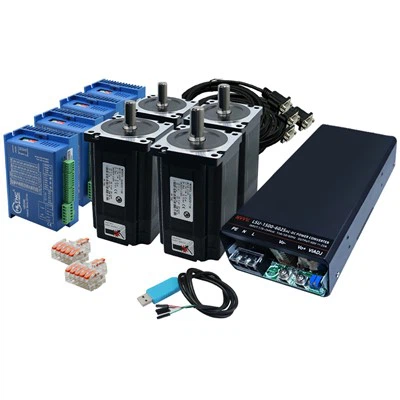
For new machines, the NEMA 23 closed-loop kit is the sweet spot - most CNC routers and small mills sit right in its torque range, and the kit comes matched (motor, encoder, driver), which removes the matching guesswork. The NEMA 34 closed-loop steps up for heavier gantries and production machines where you need the extra holding torque.
If you are upgrading an existing machine rather than building new, the honest advice is to first fix the mechanical side - a tight spot in the rails will defeat a closed-loop motor just as well as an open-loop one. Check the binding, the acceleration settings, and the current limit before you spend money on new hardware. Then, if it still loses position, closed-loop is the right upgrade.
Tell us your machine type, axis length, and what you cut - we will tell you straight whether the closed-loop premium is worth it for your case, or whether you would be paying for a feature you will never use. Email admin@hengli-hltnc.com or WhatsApp +86 13884328311.