

In the manufacturing industry, the precision of CNC (Computer Numerical Control) parts is a critical factor that directly impacts the quality and performance of the final products. As a seasoned CNC part supplier, I've witnessed firsthand how various elements come into play to determine the precision of these parts. In this blog, I'll delve into the key factors that affect the precision of CNC parts, sharing insights drawn from my experience in the field.
Machine Tool Accuracy
The primary cornerstone in achieving precise CNC parts lies in the accuracy of the machine tool itself. The geometric accuracy of a CNC machine is fundamental. Any deviations in the straightness of the axes, perpendicularity between axes, or the roundness of rotating components can lead to inaccuracies in the machined parts. For instance, if the X - axis of a CNC milling machine has a slight deviation in straightness, the parts milled along that axis may have dimensional errors.
The positioning accuracy of the machine is another crucial aspect. This refers to the ability of the machine to move to a specified position accurately. High - quality CNC machines are equipped with advanced linear encoders and servo systems that can precisely control the movement of the tool. However, over time, factors such as wear and tear of the mechanical components, thermal expansion, and electrical interference can degrade the positioning accuracy. Regular calibration and maintenance of the machine are essential to ensure its long - term accuracy. For example, a well - maintained CNC lathe with high - end servo motors and accurate ball screws can achieve positioning accuracies within a few micrometers.
Cutting Tools
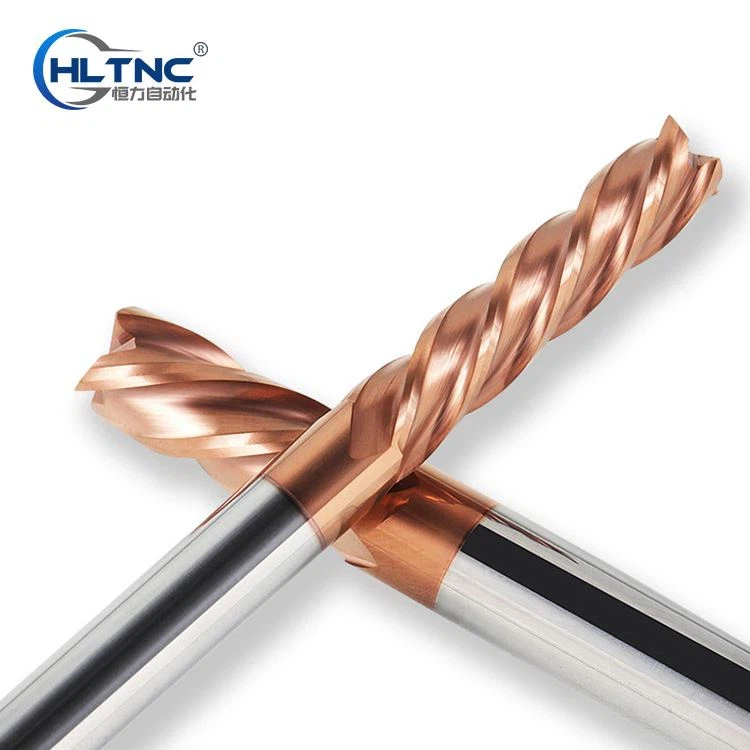
The choice and condition of cutting tools have a profound impact on the precision of CNC parts. CNC Cutting Tools 4 Flutes are a popular choice in many CNC machining operations due to their ability to provide a good balance between material removal rate and surface finish. However, the geometry of the cutting tool, including the rake angle, clearance angle, and cutting edge radius, must be carefully selected according to the material being machined and the desired precision.
Wear and tear of cutting tools are inevitable during the machining process. As the cutting edge wears, the cutting forces increase, which can lead to dimensional variations and poor surface finish of the parts. Tool wear can also cause vibration during machining, further exacerbating the quality issues. Therefore, it is crucial to monitor the tool wear regularly and replace the tools in a timely manner. Advanced tool monitoring systems can be used to detect the wear level accurately and signal when a tool needs to be changed.
Workpiece Material
The properties of the workpiece material significantly influence the precision of CNC parts. Different materials have different machinability levels. For example, materials with high hardness, such as hardened steel or titanium alloys, are more difficult to machine compared to softer materials like aluminum or brass. Harder materials require more powerful cutting tools and higher cutting forces, which can increase the risk of tool breakage and workpiece deformation.
The internal stress of the workpiece material also affects the machining precision. If the workpiece has residual stresses, machining can release these stresses, causing the part to deform. Stress - relieving heat treatment before machining can be an effective way to reduce the impact of residual stresses on the final part precision. Additionally, the homogeneity of the material is important. Materials with non - uniform grain structures or inclusions can lead to inconsistent machining results.
Programming and Control
The CNC program is the blueprint for machining the parts. Errors in programming can introduce significant inaccuracies. Incorrect feed rates, spindle speeds, or tool paths can result in over - cutting, under - cutting, or unwanted surface roughness. A well - designed CNC program takes into account the material properties, tool characteristics, and machine capabilities.
The control system of the CNC machine plays a vital role in executing the program accurately. It sends commands to the servo motors to control the movement of the tool and the workpiece. A high - performance control system with advanced interpolation algorithms can ensure smooth and precise movement. However, electrical noise and interference in the control system can disrupt the signal transmission, leading to positioning errors.
Environmental Factors
Environmental conditions can have an impact on the precision of CNC parts. Temperature is one of the most critical environmental factors. Most CNC machines and workpieces are made of materials that expand or contract with temperature changes. A small temperature variation can cause significant dimensional changes, especially for large - scale or high - precision parts. Environmental temperature control systems, such as air conditioning and temperature - controlled machining environments, can help maintain a stable temperature during machining.
Vibration is another environmental factor that affects precision. External vibrations from nearby machinery, vehicles, or even the building structure can be transmitted to the CNC machine, causing the tool to vibrate during machining. These vibrations can result in poor surface finish, increased tool wear, and dimensional inaccuracies. Anti - vibration pads or isolation systems can be used to reduce the impact of external vibrations on the machine.
Operator Skills
The skills and experience of the CNC machine operator are often underestimated but are actually very important. An experienced operator can make real - time adjustments during the machining process based on their observations. They can detect early signs of tool wear, machine malfunctions, or programming errors and take appropriate actions to correct them.
Operator training is crucial for ensuring high - precision machining. Training programs should cover a wide range of topics, including machine operation, programming, tool selection, and maintenance. By continuously improving their skills, operators can contribute to better precision and quality of the CNC parts.
Fixturing and Workholding
Proper fixturing and workholding are essential for maintaining the position and stability of the workpiece during machining. A poorly designed fixture can cause the workpiece to move or vibrate, leading to dimensional errors and poor surface finish. The fixture must be able to hold the workpiece firmly and accurately in the desired position.
The choice of workholding devices also depends on the shape, size, and material of the workpiece. For example, vise grips are commonly used for small to medium - sized parts, while magnetic chucks are suitable for flat ferromagnetic workpieces. The clamping force should be carefully controlled to avoid deforming the workpiece.
Measuring and Inspection
Accurate measurement and inspection are the final steps in ensuring the precision of CNC parts. High - precision measuring instruments, such as coordinate measuring machines (CMMs), micrometers, and calipers, are used to verify the dimensional accuracy and surface quality of the parts. Regular inspection during the machining process can help detect any deviations early and allow for timely corrections.
In addition to dimensional measurement, surface roughness measurement is also important, especially for parts that require a high - quality surface finish. Surface profilometers can be used to measure the surface roughness parameters accurately.
In conclusion, the precision of CNC parts is influenced by a multitude of factors, ranging from machine tool accuracy and cutting tools to environmental conditions and operator skills. As a CNC part supplier, we are committed to controlling these factors to ensure the highest level of precision in our products. By understanding these factors, our customers can make more informed decisions when it comes to choosing the right CNC parts for their applications.
If you are interested in our high - precision CNC parts or have any questions regarding the factors affecting precision, we invite you to contact us for procurement discussions. We look forward to working with you to meet your specific needs.
References
- Smith, J. (2018). CNC Machining Handbook. Industrial Press.
- Jones, A. (2020). Precision Engineering and Manufacturing. Springer.
- Brown, R. (2019). Cutting Tool Technology. McGraw - Hill.


