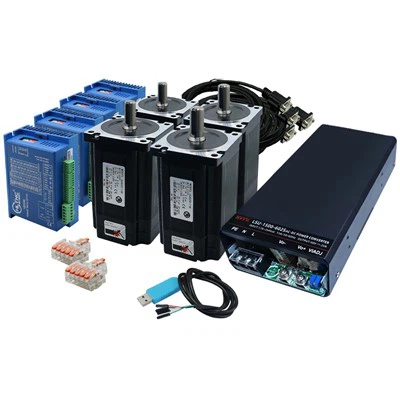
In the realm of automation and industrial machinery, motors and drivers are two fundamental components that play distinct yet complementary roles. As a trusted supplier of motors and drivers, I've witnessed firsthand the confusion that often arises between these two essential elements. In this blog post, I'll delve into the differences between motors and drivers, exploring their functions, working principles, and applications. By the end, you'll have a clear understanding of how these components work together to power various systems and how to choose the right ones for your specific needs.
What is a Motor?
A motor is a device that converts electrical energy into mechanical energy. It operates on the principle of electromagnetic induction, where a magnetic field is created by passing an electric current through a coil of wire. This magnetic field interacts with a permanent magnet or another magnetic field, causing the motor to rotate. Motors come in various types, each designed for specific applications based on factors such as power requirements, speed control, and torque.
Types of Motors
- DC Motors: These motors are powered by direct current (DC) and are known for their simplicity and ease of control. They are commonly used in applications where precise speed control is required, such as robotics, conveyor systems, and electric vehicles.
- AC Motors: Alternating current (AC) motors are the most widely used type of motor in industrial applications. They are available in two main types: induction motors and synchronous motors. Induction motors are simple, reliable, and cost-effective, making them suitable for a wide range of applications, including pumps, fans, and compressors. Synchronous motors, on the other hand, offer higher efficiency and precise speed control, making them ideal for applications where accuracy is critical, such as CNC machines and precision manufacturing.
- Stepper Motors: Stepper motors are designed to move in discrete steps, making them ideal for applications where precise positioning is required. They are commonly used in 3D printers, CNC routers, and robotic arms.
- Servo Motors: Servo motors are a type of DC motor that incorporates a feedback mechanism to provide precise control over position, speed, and torque. They are commonly used in applications where high precision and fast response times are required, such as robotics, automation, and aerospace.
What is a Driver?
A driver, also known as a motor controller, is a device that controls the operation of a motor. It provides the necessary electrical signals and power to the motor to achieve the desired speed, torque, and direction of rotation. Drivers are essential for ensuring the efficient and reliable operation of motors, as they protect the motor from overloading, overheating, and other electrical faults.
Types of Drivers
- DC Motor Drivers: DC motor drivers are used to control the speed and direction of DC motors. They can be classified into two main types: linear drivers and switching drivers. Linear drivers provide a smooth and continuous output voltage, making them suitable for applications where precise speed control is required. Switching drivers, on the other hand, use pulse-width modulation (PWM) to control the average voltage applied to the motor, making them more efficient and suitable for high-power applications.
- AC Motor Drivers: AC motor drivers, also known as variable frequency drives (VFDs), are used to control the speed and torque of AC motors. They work by varying the frequency and voltage of the AC power supplied to the motor, allowing for precise control over the motor's speed and performance. VFDs are commonly used in applications where energy efficiency and speed control are critical, such as pumps, fans, and conveyors.
- Stepper Motor Drivers: Stepper motor drivers are used to control the movement of stepper motors. They provide the necessary electrical signals to the motor to move in discrete steps, allowing for precise positioning and control. Stepper motor drivers can be classified into two main types: unipolar drivers and bipolar drivers. Unipolar drivers are simpler and less expensive, but they offer lower torque and efficiency. Bipolar drivers, on the other hand, offer higher torque and efficiency, but they are more complex and expensive.
- Servo Motor Drivers: Servo motor drivers are used to control the operation of servo motors. They provide the necessary electrical signals and power to the motor to achieve the desired position, speed, and torque. Servo motor drivers incorporate a feedback mechanism, such as an encoder or resolver, to provide precise control over the motor's operation. They are commonly used in applications where high precision and fast response times are required, such as robotics, automation, and aerospace.
Key Differences between Motors and Drivers
- Function: The primary function of a motor is to convert electrical energy into mechanical energy, while the primary function of a driver is to control the operation of the motor.
- Working Principle: Motors operate on the principle of electromagnetic induction, while drivers use electronic circuits to control the electrical signals and power supplied to the motor.
- Control: Motors typically do not have built-in control capabilities and require a driver to control their speed, torque, and direction of rotation. Drivers, on the other hand, are designed to provide precise control over the motor's operation.
- Protection: Drivers provide protection for the motor against overloading, overheating, and other electrical faults. Motors, on the other hand, do not have built-in protection capabilities and rely on the driver to protect them from damage.
- Compatibility: Motors and drivers must be compatible with each other in terms of voltage, current, and power requirements. Using an incompatible motor and driver can result in poor performance, damage to the motor or driver, and even safety hazards.
Applications of Motors and Drivers
Motors and drivers are used in a wide range of applications across various industries, including manufacturing, automation, robotics, aerospace, and automotive. Some common applications include:


- Industrial Automation: Motors and drivers are used in industrial automation systems to control the movement of conveyor belts, robotic arms, and other machinery. They are essential for improving productivity, efficiency, and quality in manufacturing processes.
- CNC Machines: CNC Motion Controller are used in CNC machines to control the movement of the cutting tool and the workpiece. They provide precise control over the speed, position, and direction of the motor, allowing for accurate and efficient machining operations.
- Robotics: Motors and drivers are used in robotics to control the movement of the robot's joints and limbs. They provide the necessary power and control to enable the robot to perform complex tasks with precision and accuracy.
- Automotive: Motors and drivers are used in automotive applications to control the operation of various systems, such as electric power steering, electric brakes, and electric windows. They are essential for improving the performance, efficiency, and safety of modern vehicles.
- Renewable Energy: Motors and drivers are used in renewable energy systems, such as wind turbines and solar panels, to convert mechanical energy into electrical energy. They provide the necessary control and power to ensure the efficient and reliable operation of these systems.
Choosing the Right Motor and Driver
Choosing the right motor and driver for your application is crucial for ensuring optimal performance, efficiency, and reliability. Here are some factors to consider when selecting a motor and driver:
- Power Requirements: Determine the power requirements of your application, including the voltage, current, and power rating. Choose a motor and driver that can provide the necessary power to meet your application's needs.
- Speed and Torque Requirements: Consider the speed and torque requirements of your application. Choose a motor and driver that can provide the desired speed and torque characteristics.
- Control Requirements: Determine the control requirements of your application, including the level of precision, accuracy, and responsiveness. Choose a driver that can provide the necessary control features to meet your application's needs.
- Environmental Conditions: Consider the environmental conditions in which your application will operate, including temperature, humidity, and dust. Choose a motor and driver that are suitable for the environmental conditions of your application.
- Cost: Consider the cost of the motor and driver, including the initial purchase price, installation costs, and maintenance costs. Choose a motor and driver that offer the best value for your money.
Conclusion
In conclusion, motors and drivers are two essential components that play distinct yet complementary roles in automation and industrial machinery. Motors convert electrical energy into mechanical energy, while drivers control the operation of the motor. Understanding the differences between motors and drivers is crucial for ensuring optimal performance, efficiency, and reliability in your applications. As a Integrated Driven Motor and driver supplier, we offer a wide range of high-quality motors and drivers to meet the needs of various applications. If you have any questions or need assistance in choosing the right motor and driver for your application, please don't hesitate to contact us. We're here to help you find the best solution for your needs.
References
- Chapman, S. J. (2012). Electric Machinery Fundamentals. McGraw-Hill Education.
- Fitzgerald, A. E., Kingsley, C., Jr., & Umans, S. D. (2003). Electric Machinery. McGraw-Hill Education.
- Krause, P. C., Wasynczuk, O., & Sudhoff, S. D. (2002). Analysis of Electric Machinery and Drive Systems. Wiley-IEEE Press.