Most of the acme lead screw questions that reach our workshop are not about the screw itself. They are about the bits around it - which nut, which end block, whether a screw jack needs a thrust bearing, and why "acme nut and bolt" turns up so many different-looking parts online.
The trapezoidal (acme) lead screw is the cheapest way to move a load in a straight line, and its accessories are simple. But simple does not mean obvious. This guide walks through the four parts people actually search for, what each one does, and where corners can be cut safely - and where they cannot.
Acme nut: the part that actually does the work
The nut is where the screw's rotation becomes linear motion, and it is the part that wears. Two decisions matter: material and flange style.
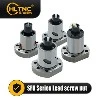
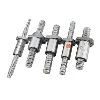
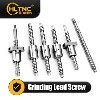
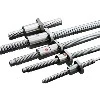
Material - plastic or bronze. Plastic nuts (often acetal/POM) are the default for 3D printers and light automation: they run dry, cost little, and self-lubricate to a point. Their weakness is heat and load - above about 5-8 kN of continuous thrust they soften and wear fast. Bronze or steel nuts handle real loads. For a CNC feed axis or a lifting platform, choose steel or bronze; plastic belongs on hobby machines. On our trapezoidal lead screw we fit cylindrical nuts and steel flange nuts, and we machine both to a matching gap of 0.05 mm or less so there is no slop at the change of direction.
Flange style - round or flange. Round nuts clamp into a housing with a setscrew and suit manual adjustment. Flange nuts bolt directly to the moving table and carry load more positively. If your existing assembly uses a flange nut, measure the bolt spacing before ordering a replacement - it is the single most common mismatch we see on returned parts.
Backlash in a nut. A plain acme nut always has some axial play unless it is a split or spring-loaded design. For positioning work, a split nut with an adjusting screw lets you take up wear as it appears - a cheap way to extend the life of an acme axis instead of replacing the nut every season.
Components are only half of the assembly - maintaining trapezoidal screw assemblies is what decides whether the nut, the end blocks and the screw itself reach their rated life.
Acme end blocks: where the screw lives
End blocks hold the screw at both ends and carry the thrust. The common mistake is treating both ends the same - they are not supposed to be.
| End | What it needs | Why |
| Drive end (motor side) | Fixed support with thrust bearings | Carries all axial load from cutting or lifting; must hold position without end-play. |
| Free end (opposite) | Plain support, allow axial float | The screw grows with temperature; a fixed-fixed setup bends it. Float prevents buckling and noise. |
If you have an existing machine and the end block is cracked or the bearing is rough, measure the block height and bore before ordering - replacement blocks must match the original centerline height or the screw axis tilts, which loads the nut unevenly and wears it in weeks. We machine end blocks and mounting flanges to your drawing as part of custom linear motion orders, so the axis keeps its original geometry.
Acme screw jack: lifting, not just sliding
A screw jack is an acme lead screw used vertically to lift a load, usually with a bevel-gear or worm input so a small horizontal motor moves a heavy vertical load. Two specifications matter more than anything else:
1. The self-locking question. A trapezoidal thread with a 30° profile self-locks when the lead angle is small enough - the load cannot turn the screw by itself. This is exactly what you want on a lifting table or gantry Z-axis: the load stays put when power is removed. It is also the main reason acme beats ball screws here - a ball screw can back-drive under load, which is why vertical ball screw axes usually need a brake. If your jack is specified "self-locking", verify the lead angle and the friction of the actual nut material - a well-greased bronze nut can unlock a marginal thread that was locking when dry.
2. Column loading. A long screw under compression buckles before it fails in thrust. For a jack, the screw must be checked as a column: the unsupported length, diameter, and end-fixity set the maximum safe lift height. As a rule of thumb for a 20 mm screw with one end fixed, keep unsupported lift under about 1 m for light loads - beyond that, add a guide or tube.
For heavy continuous lifting (cranes, stage machinery), the trapezoidal lead screw with a steel nut and proper thrust bearing is a proven, low-maintenance answer - far cheaper than a ball screw and happy to sit loaded for years.
Acme bolt and screw - the same thread, different jobs
"Acme bolt" usually means a short length of acme-threaded rod used as a bolt or as a stage-adjustment screw on machinery - a manual lift or a fine adjustment on a jig. The thing to check is the thread standard. Acme threads come in several pitches for the same diameter (for example, 1/2"-10, 1/2"-8, 1/2"-6 acme all exist), and a nut from one standard will not fit another. When buying acme rod and a matching nut separately, order them from the same supplier, or quote the thread designation exactly (e.g. Tr20×4 for metric trapezoidal, or 1/2"-10 Acme).
One table to keep on the wall
| Part | Most common mistake | Fix |
| Nut | Plastic nut on a loaded axis | Steel or bronze nut for >5-8 kN. |
| End blocks | Both ends fixed | Fixed + floating; allow thermal growth. |
| Screw jack | Assuming self-lock without checking lead angle | Verify against actual friction; add brake if marginal. |
| Acme rod & bolt | Mixing thread standards | Quote exact designation (Tr20×4 / 1/2"-10). |
Building or repairing an acme lead screw axis? Send us the screw size, nut style, and your load - we will confirm the right nut material, end blocks, and jack configuration, and quote within 24 hours.
Get a Free Quote