It usually starts with a part that quietly goes wrong. A machine that cut fine for months suddenly wanders off by half a millimeter. Or an axis stalls mid-job while the controller keeps counting pulses that never turned into motion. Nothing alarms, nothing breaks loudly. You notice when the workpiece comes off wrong, and by then the run is scrap.
That's when the upgrade debate starts, and it gets loud fast. Servo, some people say. Closed-loop stepper, others answer. Both sides type with confidence, and both are right about half of the machine. So let's walk through the trade-offs the way we do when a buyer sends over real specs, because the right answer depends on where the problem lives.
Open-loop stepping runs on trust. The controller sends pulses; the motor is expected to follow; nobody checks. If the load torque crosses the motor's limit for even a moment, the rotor stalls and steps are gone forever. The controller never learns. That's why so many machines run at half power in practice: operators derate open-loop steppers to maybe 50% of rated torque just to keep a cushion against lost steps. The quiet cost of open loop is not the driver's price tag. It's the cutting performance you're too nervous to use.
What a closed-loop stepper actually fixes
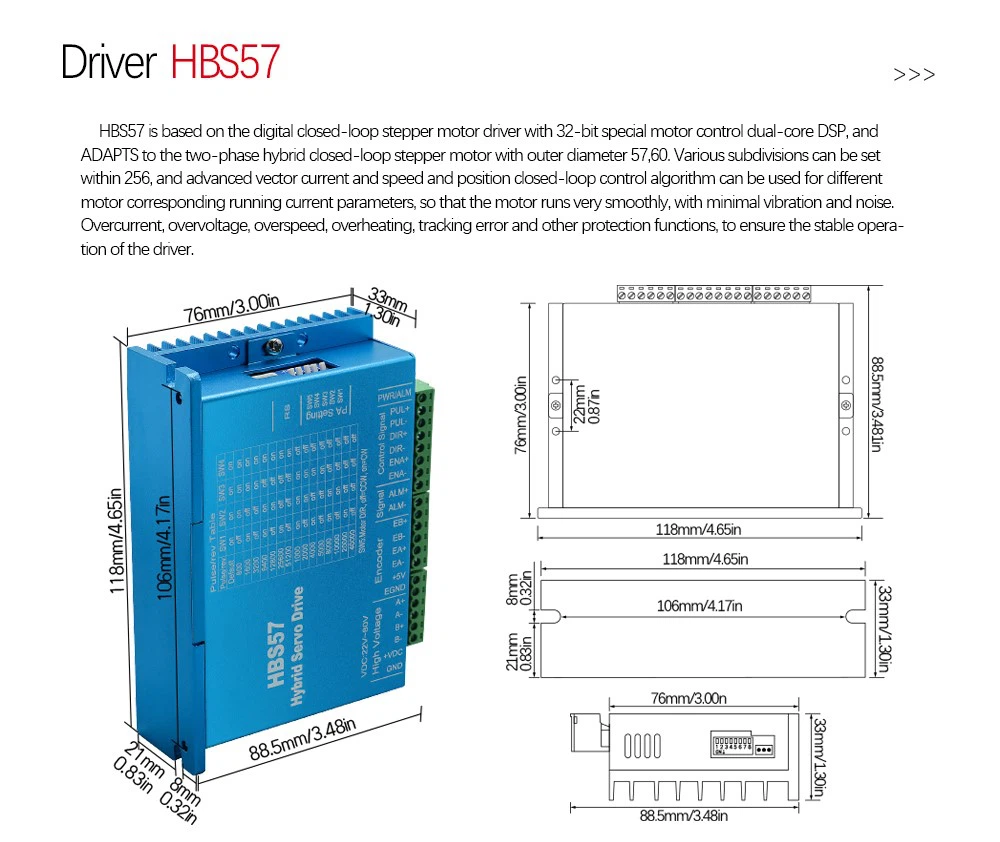
A closed-loop stepper adds an encoder to the motor shaft and checks real position continuously. The HBS57 closed-loop stepper driver is a typical example: a 32-bit dual-core DSP runs current, velocity, and position loops together and samples actual position about 20,000 times per second. When measured position drifts from where it should be, the driver corrects in the same instant instead of carrying the error to the end of the job. It drives the usual two-phase hybrid servo motors in 42-60 mm frames (NEMA 17-24) - a stepper motor with a 1000-line encoder bolted to the shaft.
Two things change on the shop floor. One: you can command close to 100% of rated torque, because the driver catches a missed step and compensates instead of absorbing it silently. Two: if the load shoves the shaft off position - a crash, a dragging way, a hand pushing the axis during setup - the loop pulls it back instead of building error into every move that follows.
The hardware side is plain: continuous current adjustable from 0 to 7 A, a 16-80 VDC supply, pulse input up to 200 kHz, and sixteen microstep settings from 400 to 51,200 per revolution. The drive also watches itself, with overcurrent, overvoltage, overspeed, overtemperature, and tracking-error protection, and an RS232 port is there for tuning and bench diagnostics. You won't need most of that on most days. It matters when a machine runs unattended.
Where the closed-loop versus servo line sits
Now the honest part. At the feed rates most CNC routers, mills, and engraving machines actually run, a closed-loop stepper holds positioning accuracy comparable to a servo. What it won't give you is the high-speed end of the range: torque holds up as rpm climbs on a servo and fades on a stepper. If the job is sustained high-speed machining with heavy cuts at high feed, no stepper, open or closed, is the right tool.
So when does closed loop beat jumping straight to servo? Three situations keep showing up.
Cost first: a closed-loop pair typically lands at 30-50% of what an AC servo system costs, counting driver, motor, and the cable between them.
Setup second: this kind of driver adjusts itself as the load changes, so there is no gain-tuning session where you watch the axis hum and hunt for an hour.
Motion profile third: closed-loop steppers handle rapid start-stop and short, frequent moves such as tool changers, small-axis positioning, and pick cycles, and once positioned they sit still with no settling wobble after the move.
| Point of comparison | Closed-loop stepper | AC servo |
|---|---|---|
| System cost | 30-50% of an AC servo system | Full price; catalog starts around $195 (3.8 kW class) |
| Tuning | Self-adjusting with load, no gain session | Modern drives auto-tune too |
| Torque at speed | Holds at moderate feed, fades at high rpm | Holds as rpm climbs |
| Positioning | Servo-comparable at typical router/mill feeds | High bandwidth contouring |
| Best fit | Lost-step fixes, short moves, moderate feed | Fast contouring, heavy chip load at speed, true speed/torque modes |
Servo earns its budget when the job needs bandwidth: fast contouring, serious chip load at speed, or true speed and torque modes rather than position alone. That class of machine belongs on the bigger end of the stepper motor driver catalog, where the range starts at about $195 and tops out around a 3.8 kW AC servo. Modern servo drives auto-tune their own gains too, so the honest difference is not setup effort. It is speed, torque at rpm, and price. And when you need the control modes, a servo driver such as the T3D absolute-encoder model runs position, speed, and torque out of one box.
What we tell buyers stuck in this decision
Most inquiries fall into two buckets. Bucket one: the machine loses steps at moderate speed, or the operator runs it derated out of caution. For that, a closed-loop retrofit is usually the faster and cheaper fix, and it keeps most of the existing mechanics. Bucket two: the machine is feed-limited, the cuts keep getting heavier, and the real problem is torque at rpm. That machine wants servo, and postponing the switch costs more in cycle time than the drive costs in a month.
A blunt way to sort yourself: run your worst case, deepest cut at the highest feed you actually need. If the axis stalls, or you are running scared of it stalling, and the speed is moderate, closed loop removes the fear without opening a tuning manual. If the axis simply cannot keep up when you raise feed to chase cycle time, that's a servo conversation, and pretending otherwise costs you parts.
One question comes up constantly: is the closed loop "close enough to servo" that we can stop thinking about it? On a machine that lives at moderate feed, yes, fit it and move on. On a machine with a speed problem, no. If you are mid-decision, send your motor frame size, supply voltage, and the worst feed rate you must hold through the inquiry page. It takes two minutes, or reach us on WhatsApp at +86 13884328311. We'll say plainly which way we'd go. Recommending a servo nobody needs is a fast way to lose a repeat buyer.
The nameplate does not cut parts. The match between the motion profile and the job does, so pick for the feed rate you actually run.