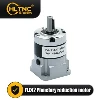
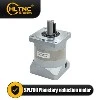
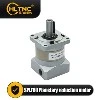
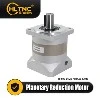
"What reduction ratio do I need?" is the question we get most often about gear reducers, and the answer is never a single number. It depends on three things we ask back: how fast your motor spins, how fast you need the output to spin, and how much torque the load actually pulls. Skip any one of those and the ratio we give you is a guess with a gearbox attached.
The math itself is the easy part. The hard part is that two reducers with the same ratio can behave completely differently, because efficiency and backlash change the whole picture. This is what we mean by that, with numbers you can check yourself.
A real example, start to finish
Say you have a 750 W servo spinning at 3000 rpm, and the turntable it drives needs to turn at 30 rpm. The nominal ratio is simple:
3000 rpm ÷ 30 rpm = 100:1
That servo makes about 2.39 Nm. With a planetary reducer at roughly 90% efficiency per stage:
2.39 × 100 × 0.9 ≈ 215 Nm at the output
With a worm reducer at 60% efficiency - same ratio, same motor:
2.39 × 100 × 0.6 ≈ 143 Nm - about a third less
Same ratio on paper, and one setup has roughly 50% more output torque than the other. That is why we never quote a ratio without knowing the application, and why "just give me a 100:1" usually ends with a phone call back. The ratio is only half the selection; the type of gear reducer decides the rest.
Planetary or worm?
Planetary
90-97% efficiency, low backlash (arc-minutes), compact for its torque. The standard for servo positioning - indexers, rotary axes, robotic joints. Costs more per Nm.
Worm
50-70% efficiency, higher backlash, but self-locking in many ratios and cheap. Good for vertical hoists and one-way loads where self-lock is a feature, not a drawback.
Ratio and efficiency set the torque you actually get, which is why reducer load and torque selection should be settled before the gearbox is ordered rather than after it is in service.
We stock both, and our high precision planetary gearbox is the one we recommend most for CNC work - the backlash figure on the datasheet is honest, and the efficiency means your servo does not waste a third of its torque inside the box.
Three mistakes show up more than any others. Buying the biggest ratio available, because it feels safer - it is not; higher ratios add inertia and backlash and slow the response. Ignoring efficiency, as if it only matters on paper. And skipping the self-lock question on vertical axes, where a worm reducer can be the difference between a held load and a falling one when power drops.
As for us - HENGLI Automation has been making reducers and motion components since 2010. If you send us your motor model, output speed and the load on the shaft through the inquiry form, we will come back with the ratio, the type and a quote, usually the same day. We have done this calculation a few thousand times by now, so it is quick.