Servo motors are a critical component in many industrial and automation applications, known for their high precision, torque control, and speed regulation. As a servo motor supplier, I understand the importance of effective control methods for these motors to ensure optimal performance. In this blog post, I will explore the various control methods for servo motors, providing insights into their principles, advantages, and applications.
Open - Loop Control
Open - loop control is the simplest form of servo motor control. In an open - loop system, the controller sends a control signal to the servo motor without receiving any feedback about the motor's actual position, speed, or torque. The motor responds to the input signal based on its pre - determined characteristics.
The main advantage of open - loop control is its simplicity and low cost. It does not require additional sensors for feedback, which reduces the overall system complexity and cost. However, open - loop control lacks accuracy and is not suitable for applications that require high precision. For example, in a simple conveyor belt system where the speed does not need to be precisely regulated, open - loop control can be sufficient.
Closed - Loop Control
Closed - loop control is a more advanced and widely used method for servo motor control. In a closed - loop system, the controller continuously monitors the motor's actual position, speed, or torque using feedback sensors such as encoders or resolvers. The controller then compares the actual values with the desired values and adjusts the control signal accordingly to minimize the error.
Position Control
Position control is one of the most common applications of closed - loop servo motor control. In position control, the goal is to move the motor to a specific position with high accuracy. The controller receives the desired position command and uses the feedback from the position sensor to calculate the error between the actual and desired positions. It then adjusts the motor's speed and torque to reduce the error until the motor reaches the desired position.
Position control is widely used in robotics, CNC machines, and automated assembly lines. For example, in a robotic arm, position control ensures that the arm can move to the exact location to pick up or place an object. Our Nema 17 Integrated Stepper Motor can be effectively used in position control applications, providing high - precision movement.
Speed Control
Speed control is another important application of closed - loop servo motor control. In speed control, the controller maintains the motor's speed at a constant value regardless of the load or other external disturbances. The controller measures the motor's actual speed using a speed sensor and compares it with the desired speed. It then adjusts the motor's input voltage or current to keep the speed within the specified range.
Speed control is commonly used in applications such as pumps, fans, and conveyors. For example, in a water pump, speed control ensures that the pump operates at a constant speed to maintain a stable water flow. Our Nema 17 Stepper Motor Driver can be used to achieve precise speed control for stepper motors.
Torque Control
Torque control is used when the application requires precise control of the motor's torque output. In torque control, the controller adjusts the motor's current to produce the desired torque. The torque is measured using a torque sensor, and the controller compares the actual torque with the desired torque and makes adjustments accordingly.
Torque control is important in applications such as tension control in winding machines and force control in robotic grippers. For example, in a wire - winding machine, torque control ensures that the wire is wound with a consistent tension.
Advanced Control Algorithms
In addition to the basic closed - loop control methods, there are several advanced control algorithms that can be used to improve the performance of servo motors.
PID Control
PID (Proportional - Integral - Derivative) control is one of the most widely used control algorithms in servo motor control. The PID controller calculates the control signal based on the proportional, integral, and derivative of the error between the actual and desired values. The proportional term provides an immediate response to the error, the integral term eliminates the steady - state error, and the derivative term predicts the future error and helps to dampen oscillations.
PID control is simple to implement and can provide good performance in many applications. However, it may require careful tuning of the PID parameters to achieve optimal performance.
Fuzzy Logic Control
Fuzzy logic control is a control method based on fuzzy set theory. It uses linguistic variables and fuzzy rules to make control decisions. Fuzzy logic control is more suitable for systems with complex and uncertain dynamics, where it is difficult to establish an accurate mathematical model.
Fuzzy logic control can handle non - linearities and uncertainties in the system better than traditional control methods. It can also provide a more intuitive and human - like control strategy.
Neural Network Control
Neural network control uses artificial neural networks to model the system's behavior and generate control signals. Neural networks can learn the complex relationships between the input and output of the system through training.
Neural network control can adapt to changes in the system's dynamics and provide excellent performance in highly non - linear and complex systems. However, it requires a large amount of training data and computational resources.
Power Supply Considerations
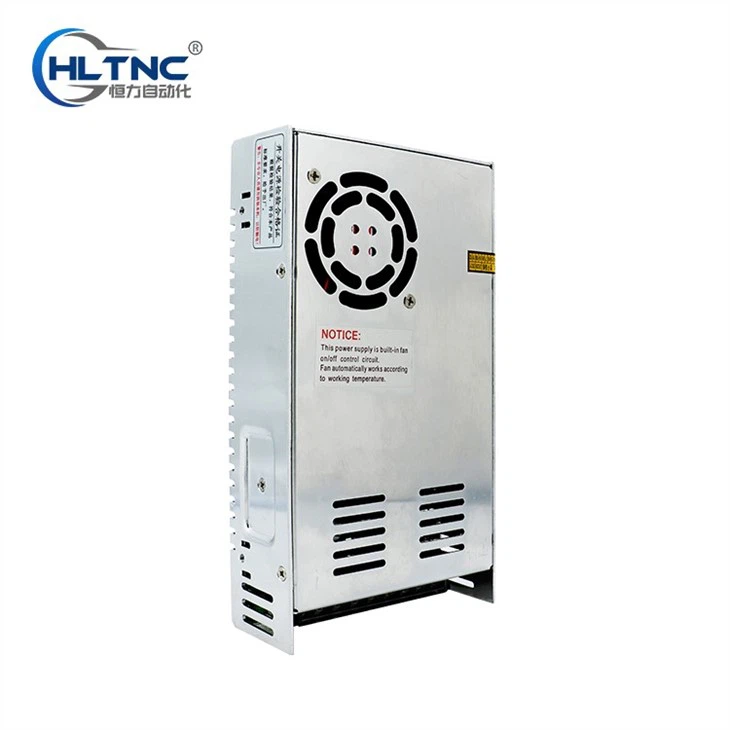
The power supply is an important factor in servo motor control. A stable and appropriate power supply is essential for the proper operation of the servo motor. Our CNC Power Supply is designed to provide a reliable power source for servo motors and other related components in CNC systems.
The power supply should be able to provide the required voltage and current for the servo motor. It should also have good voltage regulation and low ripple to ensure stable motor operation. In addition, the power supply should be protected against over - voltage, under - voltage, over - current, and short - circuit conditions to prevent damage to the motor and other components.
Conclusion
In conclusion, there are various control methods for servo motors, each with its own advantages and applications. Open - loop control is simple and cost - effective but lacks accuracy, while closed - loop control provides high precision through feedback. Advanced control algorithms such as PID, fuzzy logic, and neural network control can further improve the performance of servo motors in complex applications.
As a servo motor supplier, we offer a wide range of products, including Nema 17 Stepper Motor Driver, Nema 17 Integrated Stepper Motor, and CNC Power Supply, to meet the different needs of our customers. If you are interested in our products or have any questions about servo motor control, please feel free to contact us for further discussion and potential procurement opportunities.

References
- Dorf, R. C., & Bishop, R. H. (2017). Modern Control Systems. Pearson.
- Ogata, K. (2010). Modern Control Engineering. Prentice Hall.