Ball Screw vs Lead Screw: Precision, Speed and Cost Compared
A few times a month a customer asks us whether they can save money by using a lead screw instead of a ball screw - usually on a new machine design, usually because the difference in price is hard to ignore on paper.
The short version: yes, you can, and sometimes you should. But the two are not interchangeable in the way the price difference suggests, and the wrong choice shows up later as positioning errors or a worn-out axis that costs more to fix than the screw itself did. Here is how we think about the trade-off when we are recommending one.
Where the precision difference actually lives
A ball screw and a lead screw both convert rotary motion into linear travel, and both can be manufactured to tight tolerances. The difference is in how they handle the load and the backlash.
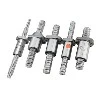
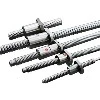
Ball screws use recirculating balls between the screw and the nut, which gives them two things a lead screw cannot match: very low friction and very low backlash - especially when the nut is preloaded. Preload takes the clearance out of the nut-to-screw contact, which is exactly what makes a ball screw hold position reliably under a cutting load that changes direction constantly. We covered what preload and backlash actually mean in practice in our earlier article on ball screw preload and backlash - the short version is that for any axis that reverses direction under load, this is the property that keeps your parts accurate.
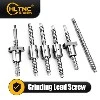
A lead screw (often with an acme or trapezoidal thread) has sliding contact between the screw and nut. It can be made very accurate in a single direction, but it has inherent backlash at reversal unless you add an anti-backlash nut, and those wear. For a lightly loaded, low-speed axis that mostly moves one way - a Z axis on a small machine, an adjustment axis - that is frequently good enough.
Speed and efficiency: the gap widens as you push harder
This is the number people skip, and it is often the deciding one.
Sliding contact means friction, and friction means the lead screw loses a significant share of the input energy as heat - typically 20-50% depending on the lead angle and material. A ball screw runs at 85-95% efficiency. In practice:
- At low speed and light load, the efficiency gap barely matters. Both do the job.
- At higher feed rates, the lead screw's friction starts to limit how fast you can go before heat becomes a problem - and heat changes the screw's dimensions, which quietly undoes your accuracy.
- With a larger motor requirement: the lead screw needs more torque to deliver the same thrust, which pushes you toward a bigger motor and drive. That cost often eats the savings from the cheaper screw.
Once you add all of that up, a lead screw only wins on cost when the application is genuinely slow and light.
Lifetime and maintenance
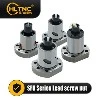
Ball screws need lubrication and occasional attention, and the balls and tracks do wear - but wear is gradual and predictable, and a quality screw from a proper factory will run for years in a CNC application. We machine our own SFE series and SFU series with hardened and ground raceways, and the failure mode customers see most is not the screw wearing out but the machine running without lubrication long past the point it should have been serviced.
Lead screws have a different failure mode: the nut threads wear against the screw, and on an acme nut the wear shows up as growing backlash over time. With an anti-backlash nut you can take some of that out, but it is a consumable part. On a machine that runs all day, that becomes a maintenance line item you did not plan for.
One more thing: vertical axes and holding position
Vertical axes deserve their own mention, because gravity does not take a break. On a Z axis, the question is not only how accurately the screw positions the load, but whether it holds position with the power off. A ball screw driven by a motor with a brake, or with a self-locking lead screw, behaves very differently when the power cuts. A coarse-lead ball screw back-drives easily - the axis can drop when the servo releases. A fine-lead lead screw is often self-locking, which is a genuine safety advantage on small vertical axes. This is one of the rare cases where a lead screw legitimately beats a ball screw, and we point it out whenever a customer is designing a Z axis on a budget.
So which one should you buy?
Our recommendation, in plain terms:
- CNC axis, any real cutting load, bidirectional positioning - ball screw, no question. This is what they are for.
- Slow, light, single-direction positioning (adjusters, small Z axes, DIY machines on a tight budget) - lead screw with an anti-backlash nut is a legitimate cost choice.
- Very long travel (over a couple of meters) - honestly, look at a rack and pinion before either; a long ball screw whips at speed, and we have seen plenty of machines that should have been racks.
If you are designing a machine and want the screw sized properly the first time - length, diameter, lead, preload class, end machining - send us your travel, load, speed and accuracy targets. We build these every day and we will tell you straight whether you need a ball screw, or whether a lead screw genuinely saves you money without costing you accuracy. Email admin@hengli-hltnc.com or WhatsApp +86 13884328311.