






DM430S Two Phase Digital Stepper Driver 0.2-3.2A
The DM430S is a two phase digital microstep driver. It delivers 0.2 to 3.2 A peak across 16 current settings, runs from DC 8-50 V or AC 6-35 V, and takes pulse input to 300 kHz with 16 microstep settings up to 25600 pulses per revolution.
Overview
This is the driver that sits behind a small to mid size stepper axis: 28 to 60 frame motors, a single pulse and direction pair from the controller, and a power supply somewhere between 24 and 48 V DC. It is set entirely by DIP switch, so nothing needs a serial connection or a laptop at the machine.
The control loop is PI based, which is what keeps the motor quiet at standstill and reduces the low speed resonance that makes an open loop drive buzz. Current drops to half automatically one second after the last pulse, so a motor holding position does not sit at full current and cook.
Specifications
| Model | DM430S two phase digital stepper driver |
| Output current | 0.2 - 3.2 A peak, 16 settings |
| Supply voltage | DC 8-50 V or AC 6-35 V, polarity free input |
| Pulse frequency | 0 - 300 kHz |
| Microstep | 16 settings, up to 25600 ppr (default 256) |
| Control signals | PUL / DIR / ENA, 3.3-24 V, opto-isolated |
| Standby current | Reduced to half after 1 s without pulses |
| Protection | Over current, over voltage, under voltage, motor phase open |
| Dimensions | 96 x 87.5 mm |
| Weight | 120 g |
| Ambient | 0 - 50 degrees C, 40-90% RH, natural or forced cooling |
DIP settings
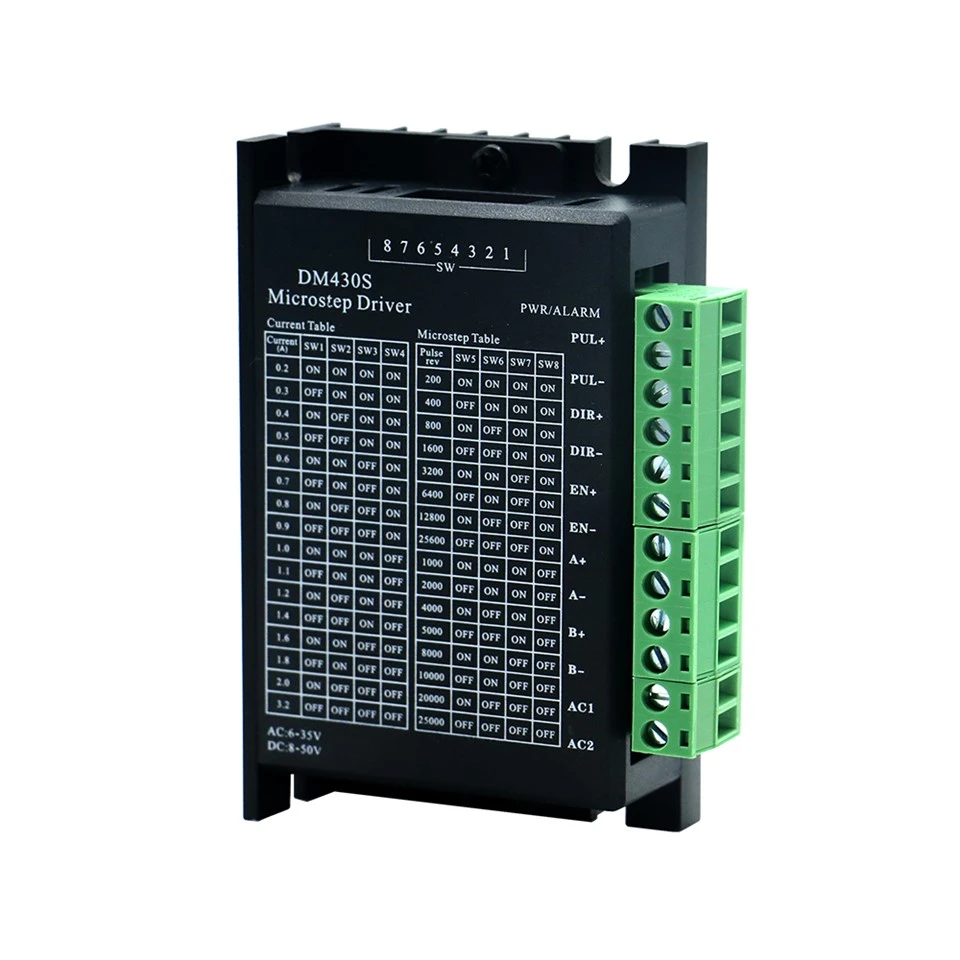
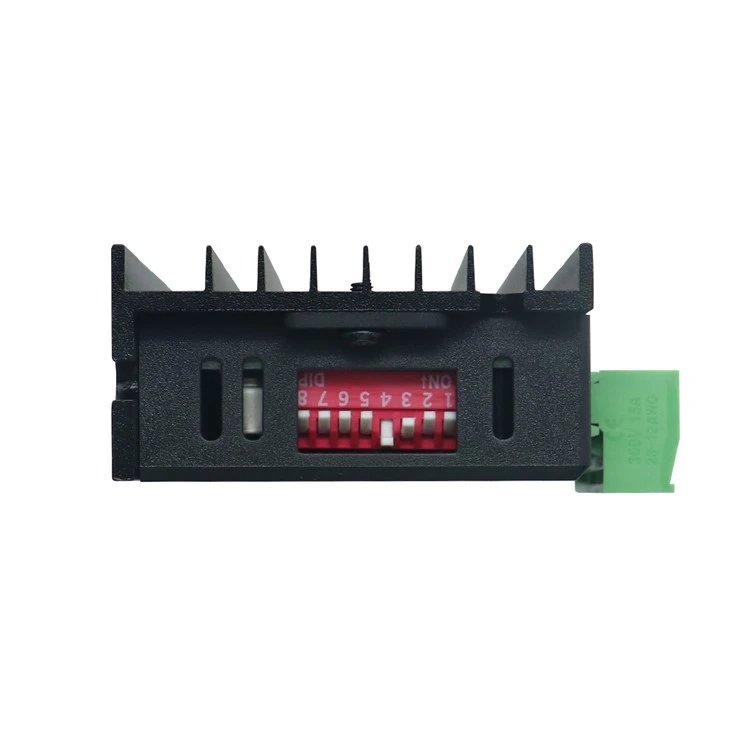
Eight switches, split into two groups. SW1 to SW4 set the peak current, from 0.2 A up to 3.2 A in sixteen steps. SW5 to SW8 set the microstep, from 200 pulses per revolution up to 25600. The factory default microstep is 256, which is a sensible starting point for a 1.8 degree motor on a screw axis.
Set the current to the motor's rated phase current, not to the highest setting the driver can reach. A driver set above the motor rating runs hot and protects itself at the worst possible moment.
Wiring
The supply terminals take AC or DC with no polarity requirement on the input. Motor phases go to A+ A- B+ B-; swapping one pair reverses the direction of rotation, which is the normal way to match the driver to the axis rather than rewiring the controller.
The DIR input sets direction by level, not by edge, and it has to be established at least 5 microseconds before the pulse train starts. If direction is reliable on slow moves but flips on fast ones, the cause is usually the DIR timing rather than the driver.
Diagnosis
One LED tells you the state. Green steady means running normally. One red flash is an over current trip, two red flashes is over voltage, and a repeating pattern of N flashes is another fault. That is enough to tell a supply problem from a motor or wiring problem without a meter.
FAQ
Which motors does it drive?
28 to 60 frame two phase hybrid stepper motors, within the 0.2-3.2 A peak range and the 8-50 V DC supply window.
Can I use a 24 V supply?
Yes. DC 24 V sits inside the range, though torque at speed improves with a 36 or 48 V supply because the driver has more voltage headroom to push current into the winding.
Why does the motor get weaker at high speed?
That is the motor's inductance, not the driver. Raising the supply voltage within the 50 V limit is the usual fix before changing anything else.
Does it need a heatsink?
At low current in an open cabinet, no. Above roughly 2 A continuous, mount it on a metal panel and keep it out of the heat plume of the motor.
Related products
HBS860H closed loop stepper driver · HBS57 stepper driver · 2 phase stepper motor · CNC power supply · Ask for a quotation
Hot Tags: dm430s,stepper driver 3.2a,microstep driver,digital stepper driver,2 phase stepper driver, 180 servo motor, ac servo motor controller, driver ac servo, micro servo motor, motor and driver for forklifts, motor and driver for table fans
You Might Also Like


Send Inquiry